
Sushi
History of sushi Type of Edomae-zushi Type of Takeout or Homemade Sushi How to enjoy sushi Kaiten-zushi
History of Sushi
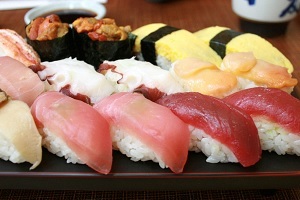
Originally, Japanese people had pickled fish to preserve from spoiling.
It was a fermented food.
But in the 17th century, vinegar came to be used to ferment.
Since the 19th century, sushi was made by laying slices of raw fish on rice and rolling it by hand, in Edo (current Tokyo).
Because, Edo citizen disliked being slow and weren't able to wait until fish pickle is completed.
On the other hand, a lot of fresh fish had always been caught in Tokyo Bay in front of the city of Edo.
As a result, to eat whenever they want, they created a snack food "sushi" using fresh raw fish and the rice with the taste of fermentation by vinegar.
It is said that the word "sushi" is derived from an archaic Japanese adjective meaning "sour".
And, the words "in front of the city of Edo" is "Edomae" in Japanese.
So the sushi born in Edo has been called Edomae-zushi.
(The word "sushi" sometimes changes to "zushi" when other word is connected.)
Types of Edomae-zushi
Nigiri-zushi
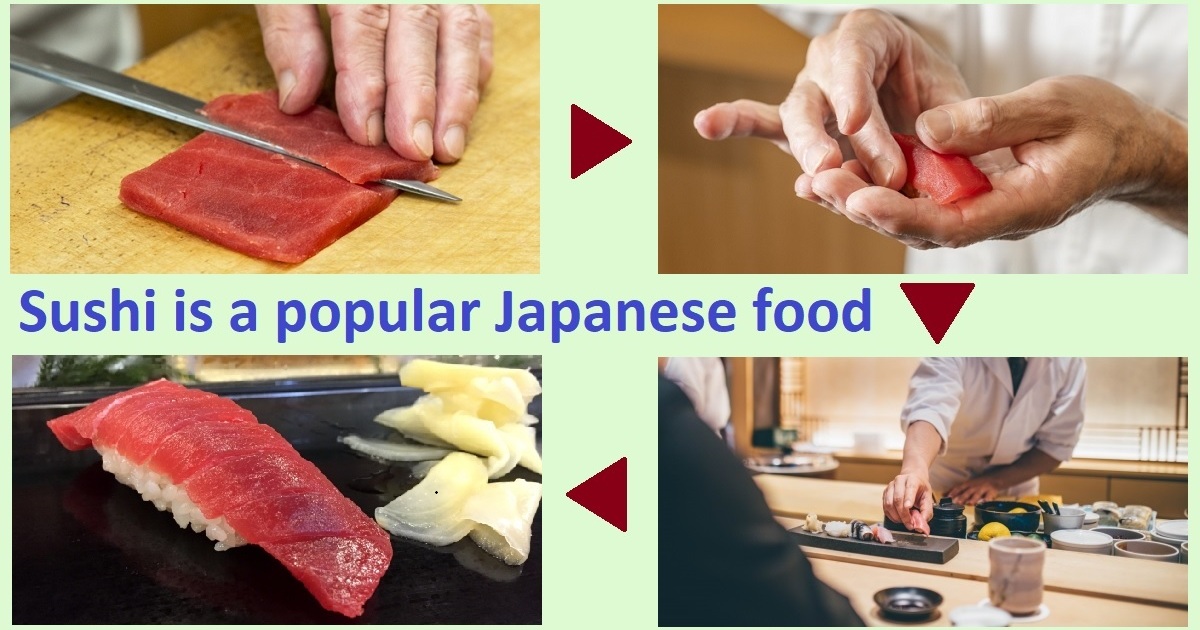
Nigiri-zushi is the most typical form of sushi.
"Nigiri" means "gripping".
The sushi chef presses half handful vinegared rice between the palm of his hands, and covers it with an ingredient.
At that time, a bit of wasabi (grated Japanese horseradish) is added as a spice.
If the ingredient is hard to hold the rice, he binds them with a thin band of nori.
Nigiri-zushi is often served in pairs when we ordered one favorite ingredient in sushi restaurant.
The style of service is a custom from ancient times.
The ingredients of nigiri-zushi are basically fresh raw fish, and they are same as sashimi.
Maguro (Tuna) - King of Sushi topping
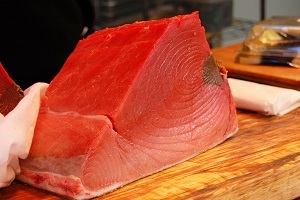
Chunk of tuna in fish market
Japanese people's favorite fish for sushi is maguro (tuna).
Maguro is large migratory fish, and the fishermen travel from the coastal waters of Japan to the open ocean to catch them.
Catching maguro is costly, but because it's so popular, the price is high.
The raw flesh is dark red.
It is divided into three parts depending on the amount of fat it contains.
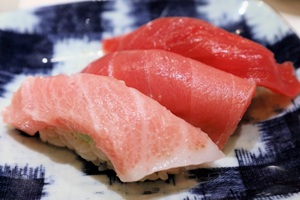
From the front to back: Ō-toro, Chū-toro, Akami
The main part is called Akami (Red flesh) in Japanese.
It is the part with a low fat content.
The fattest part in a tuna is called "toro" and the color is pinkish red.
It has a rich, sweet flavor and melts in your mouth.
Toro is divided into two ranks.
Many parts are called Chū-toro (Medium toro).
The fattiest part is especially called Ō-toro (Great toro), and the part is not very large.
("ū","ō" are the long pronunciations of "u" and "o".)
Of course, toro is more expensive than Akami.
Various Sushi toppings
Various fish are used as the ingredient of Nigiri-zushi.
Each fish has a name, and you order the favorite sushi by the name when you eat in an authentic sushi restaurant.
Basically, raw fish are main.
But, prawn and octopus are mainly boiled.
Anago (Whitespotted conger) and eel are cooked as kabayaki (broiling with the sauce of shoyu and mirin).
In addition, there is an ingredient of omelet and it is called "Gyoku".
It is made by frying beaten eggs mixed with Japanese dashi broth soup.
The following ingredients are popular for Japanese people.
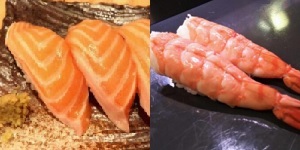
Salmon, Ebi (Boiled shrimp)
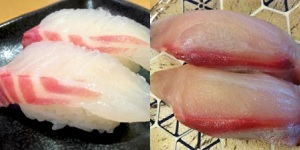
Tai (Sea bream), Hamachi (Yellow tail)
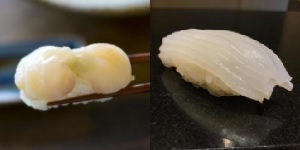
Hotate (Scallop), Ika (Squid)
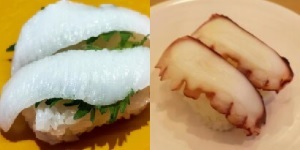
Engawa (Edge part of fish), Tako (Boiled octopus)
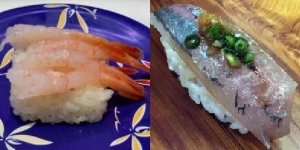
Amaebi (Raw pink shrimp), Aji (Horse mackerel)
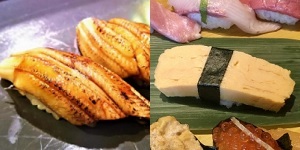
Anago (Whitespotted conger), Gyoku
Gunkan-maki
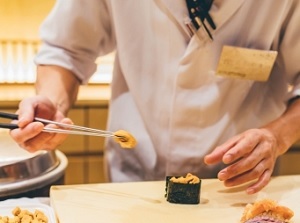
Gunkan-maki is made by making a lump of handful vinegared rice, wrapping with a strip of nori, and filling in any ingredient as the topping.
The toppings are mainly Ikura (salmon roe), Uni (sea urchin), or Negitoro (minced tuna and chopped green onion), which are pulpy or loose ingredients.
The sushi of this type was invented by a sushi chef in Tokyo in 1941.
Therefore, because it is an exceptional type of sushi, traditional sushi bars make Gunkan-maki using only a few ingredients.
In Kaiten-zushi (Conveyor belt sushi) restaurants, various toppings such as Natto, Kanimiso (Innares of crab), Corn, etc. are added on the menu.
By the way, "Gunkan" means "warship".
This is named in that form.
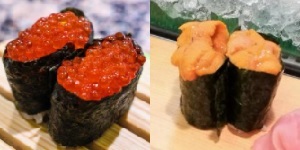
Ikura (Salmon roe), Uni (sea urchin)
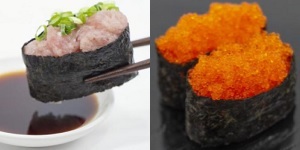
Negitoro, Tobiko (Flying fish roe)
Maki-zushi
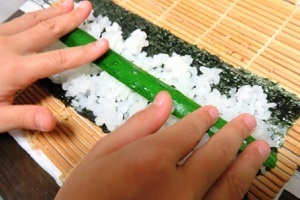
Maki-zushi means Sushi roll.
A maki-zushi is made by putting a sheet of nori on a bamboo mat, spreading vinegared rice and ingredients on it.
And, it is rolled with the help of a bamboo mat.
Usually it is served after cutting into several pieces.
There are some typical maki-zushi.
Kanpyo-maki is filled with Kanpyo (gourd strip) boiled with sweetened soy sauce.
Tekka-maki is filled with raw tuna.
Kappa-maki is filled with cucumber.
The diameter is within 3 cm, and these sushi rolls are collectively called Hoso-maki (Thin roll).
And, Futo-maki (Thick roll) is also popular sushi roll.
It is 4 to 5 cm in diameter and is often made with several fillings such as kanpyo, cucumber, omelet, etc.
Futo-maki are sometimes made at home.
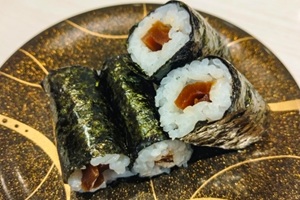
Kanpyo-maki
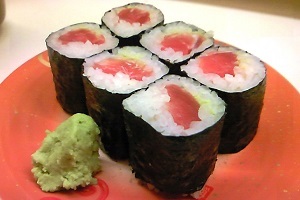
Tekka-maki
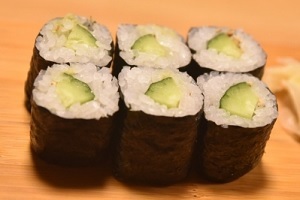
Kappa-maki
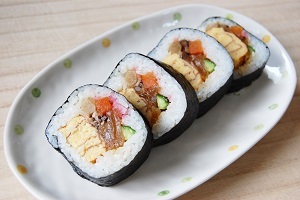
Futo-maki
California rolls are not made in sushi restaurants in Japan
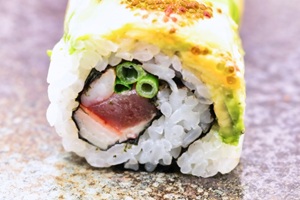
California roll privately made by a chef
"California Roll" was invented by a Japanese sushi chef in Los Angeles, US in 1963.
This isn't a traditional sushi of Japan.
Contrary to traditional maki-zushi, the outside of California Roll is rice, and nori is inside the roll.
Raw fish and wasabi aren't used, but avocado, cucumber, boiled crab meat etc. are used with mayonnaise, generally.
The reason was that raw fish and nori were not accepted to the customers in US.
It is popular in US and some other countries.
But, Sushi restaurants serving California rolls are very rare in Japan.
On the other hand, some Kaiten-zushi (Conveyor belt sushi restaurants) include California rolls on their menus as a unique type of sushi.
Most Japanese people think that California Roll is a unique rice food different from traditional sushi.
Frankly speaking, Japanese people don't want to eat those kinds of food at a sushi restaurant.
Types of sushi for takeout or making at home
Sushi roll is sometimes made at home.
But, it is difficult for common people to make Nigiri-zushi and Gunkan-maki, because much skill are needed to make them well.
On the other hand, there are a few types of sushi which sushi chef seldom make.
Oshi-zushi
Oshi-zushi means pressed sushi.
It is a block-shaped sushi formed using a wooden mold.
The cook puts the toppings of the sushi on the bottom of the wooden mold.
Vinegared rice is covered on them.
And the cook presses the lid of the mold down to create a compact sushi block.
The completed block is removed from the mold, and it is cut into bite-sized pieces.
Oshi-zushi has developed in western Japan rather than Tokyo.
Historically, this method is older than Nigiri-zushi.
When you travel around western Japan, you can find various oshi-zushi.
Most of them are sold at sushi shop etc. for takeout.
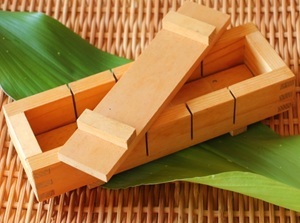
Wooden mold for Oshi-zushi
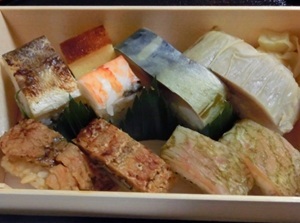
Set of Oshi-zushi
Local and typical oshi-zushi are the following.
Oshi-zushi of Saba (Mackerel) spreads widely in western Japan.
Battera in Osaka is popular as oshi-zushi of Saba.
Saba is marinated in vinegar and thin-sliced konbu (a seaweed) sheet is coated on the fish.
It is pressed for the sushi.
And, Masu (Trout), Anago (Whitespotted conger), Aji (Horse mackerel), etc. are used in each local area.
For portable lunch, there are a few oshi-zushi wrapped with leaves having bactericidal activity.
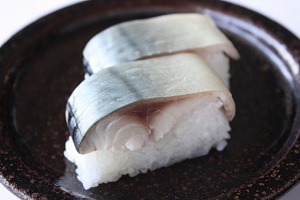
Battera
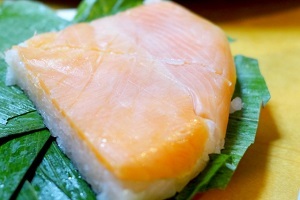
Oshi-zushi of Trout
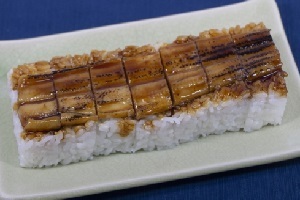
Oshi-zushi of Anago
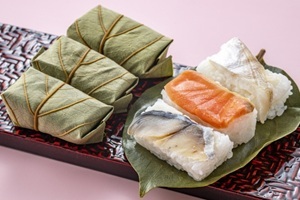
Oshi-zushi wrapped with persimmon leaves
Inari-zushi
Inari-zushi is a pouch of abura-age filled with vinegared rice.
Abura-age is a processed food that thin-sliced tofu is fried in deep-oil.
As the abura-age is boiled in the soup of shoyu and sugar in advance, it becomes salty-sweet taste.
And, vinegared rice is filled inside of the abura-age.
General sushi restaurants don't serve inari-zushi.
Rather, it is a homemade meal and has been made for special occasions.
Recently, it is eaten as one of foods for lunch and we can buy it at supermarket or convenient store.
At that time, inari-zushi and some maki-zushi are often packed in a lunch box and it is sold.
It is called "Sukeroku".
The name comes from a handsome boy in an old Kabuki drama.
It is said that this name was given to the lunch box that was eaten during the intermissions of Kabuki performances.
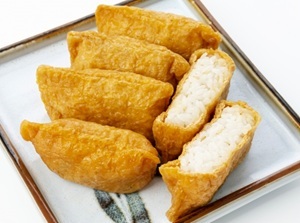
Inari-zushi
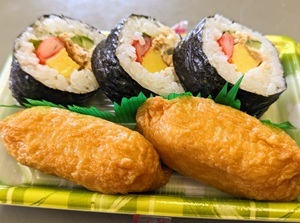
Sukeroku pack
Chirashi-zushi
Chirashi-zushi is made by scattering various ingredients on vinegared rice in a bowl.
Because it is easy to make and looks gorgeous, it is commonly made in home on happy occasions.
The ingredients on the rice are whatever the family likes.
In most sushi restaurants, the chirashi-zushi topped with some kinds of raw fish is served as lunch.
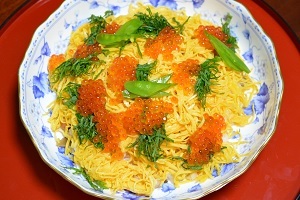
Homemade Chirashi-zushi
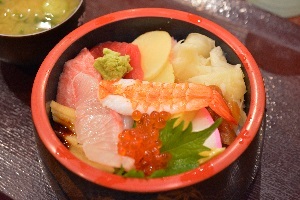
Chirashi-zushi of sushi restaurant
How to enjoy sushi
Entering a sushi restaurant
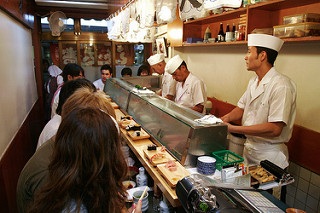 Tsukiji sushi bar, Photo by Bryan Allison
Sushi restaurants generally have counter seats and table seats.
Sushi restaurants that primarily feature counter seating are sometimes referred to as "sushi bars" in English.
First, a wet towel, a soy sauce plate, chopsticks, and "Gari" will be placed in front of you.
A wet towel is for keeping your hands clean during your meal.
Gari is thinly sliced ginger pickled in sweet vinegar.
It is used to refresh the palate between meals.
(Check the page of Japanese pickles.)
If you're sitting at the counter, you place your order directly with the chef in front of you.
If you are seated at a table, place your order through the waiter.
Of course, you can also order alcoholic beverages such as sake and beer.
Ordering style
Set menu
Set menus are the safest option to order, and the pricing is easy to understand.
8 to 12 popular types of fish are served in a balanced combination on a single plate as a set.
Basically, one piece of sushi is placed on each type of sushi.
individual orders
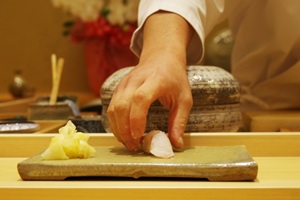
Sushi chef serves a sushi to the customer at the counter
You specify the fish you want to eat and place your order.
The chef will immediately prepare the sushi with the fish, and it is served to you within a few minutes.
Basically, one order is served with two pieces.
You can order the fish you want to eat in order and eat as much as you like.
Therefore, you cannot place an order unless you know the name of the fish.
Each Sushi restaurant always havs at least a dozen different kinds of fish.
The names of the fish are displayed in Japanese.
Check the page of Ingredients of Japanese cooking (Fish, Meats, Eggs).
Major restaurants include sashimi, various Japanese dishes and Japanese soups on their menus.
The price will be the total amount of all orders.
Individual prices are often not displayed on the menu, so you should be prepared for the cost to become quite high without you realizing it.
Omakase
"Omakase" is a casual Japanese expression meaning "It's up to you."
The chef uses the ingredients available that day and serves sushi and Japanese dishes in the best order, taking into account the customer's pace.
It is like a course meal.
But, the chef will need to communicate with you to some extent to understand your likes and dislikes and your eating pace.
You should also clearly communicate your wishes to the chef.
The prices are sometimes determined by the course you choose.
If not, you can tell the chef your desired price range, and they can create a course menu that fits that price.
How to eat
Sushi was originally eaten by picking it up with your fingers.
So, it is still acceptable to eat them by picking them up with your fingers.
However, even for Japanese people today, doing that well is surprisingly difficult.
So, in sushi restaurants, few people eat sushi with their hands and most people eat it with chopsticks.
You should also eat sushi with chopsticks.
It's common sense to eat one piece of sushi in one bite.
You pinch the sushi, and dip the ingredient side of the sushi in shoyu (soy sauce).
You must not "soak" sushi in shoyu.
It is enough to dip a little.
Put it into your mouth with keeping ingredient side down.
(If you dip the rice side in shoyu, the sushi may break.)
Order of eating
Of course, you can eat sushi of your favorite ingredients.
But many chefs advise that you should not keep eating same fish but enjoy various fish.
They say "First plain, and gradually richer. Maki-zushi in the end".
This is the better method to enjoy each taste of ingredients.
For example:
- White fish : Tai (Sea bream), Hirame (Flounder)
- Silver‐skinned fish : Aji (Horse mackerel), Hamachi (Yellowtail)
- Red fish : Maguro (Tuna), Salmon
- Other plain-taste fish : Ika (Squid), Tako (Octopus)
- Other various fish : Shellfish, Ebi (Shrimp)
- Gunkan-maki : Uni (Sea urchin), Ikura (Salmon roe)
- Teriyaki fish : Anago (Conger eel), Unagi (eel)
- Sushi roll : Tuna roll, Cucumber roll
- Omelet (As a desert)
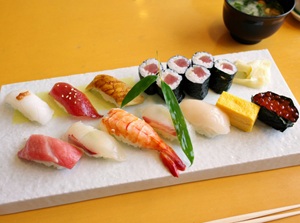
Set of Nigiri-zushi
If you can't know how to order, you can leave it to the chef.
He is supposed to serve the best choice to you.
The easiest method is to order a set menu.
8 to 12 pieces of Nigiri-zushi are arranged on a plate.
Eating from left to right on the plate results in an order similar to that.
Kaiten-zushi
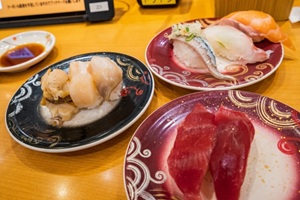
Each plate has an inexpensive price in Kaiten-zushi.
Kaiten-zushi is a type of restaurant that you can eat sushi at a low price.
In English, it's translated as "Conveyor belt sushi" or "Sushi-go-round".
They are usually chain restaurants.
The restaurant has many tables, and next to each table there is a conveyor lane that delivers sushi.
Sushi rice balls are mass-produced by robots, the toppings are sliced in a factory and delivered to the restaurants, and they are made into sushi in the restaurant by the chefs.
Because it's mass-produced, you can eat sushi at a very low price.
The sushi is served on a small plate with one to three pieces on it.
Generally speaking, the sushi rice balls at Kaiten-zushi are said to be slightly larger than those at traditional sushi restaurants.
Price per plate is set at a few different levels depending on the type of ingredients.
Each plate's color indicates its price.
Even so, the price of one plate is around 120 to 500 yen.
The menu features not only popular fishes served at traditional sushi restaurants, but also many creatively crafted toppings, including meat, vegetables, and fried foods.
There are some side dishes in the menu, and you can also order beer, sake, soft drinks, and desserts.
You can order online at your table, and the plates are delivered to you via a conveyor belt.
During the meal, there is very little communication with the chef or staff.
The number of plates piled up on the table after you have finished eating will tell you how much the meal cost.
Many chains of kaiten-zushi are in Japan.
The following are the main kaiten-zushi restaurant chains.