
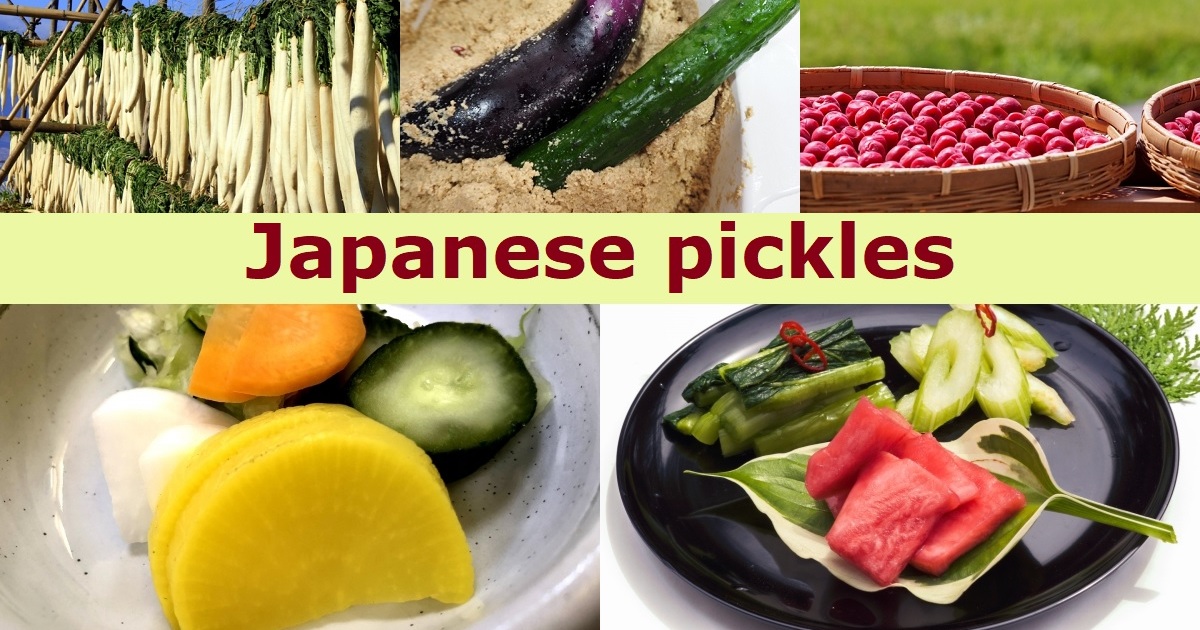
Japanese pickles
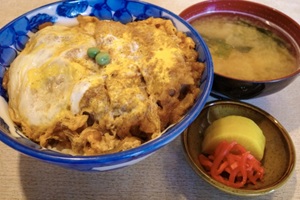
Set meals are usually served with pickles
There are many kinds of pickles in Japan.
When you eat Japanese meal, maybe a small plate of Japanese pickles is served.
Since a long time ago, pickling was one of the fundamental ways to preserve food in Japan, so pickles is a daily essential.
Most Japanese pickles are pickled in salt, rice bran (nuka), sake lees, miso or vinegar.
Simple pickles are made in half a day to three days.
And, more elaborate ones are pickled for several weeks to several months.
Daikon (Japanese radish), Hakusai (Chinese cabbage), cucumbers, turnips, eggplants, gingers are mainly used among vegetables.
And ume (Japanese plum) is used among fruits.
In Japanese, pickles are called Tsukemono or politely Otsukemono.
The following pickles are popular across the country.
In addition, Kyoto has various local tsukemono, and they are the popular souvenirs in Kyoto.
Popular pickles
Umeboshi
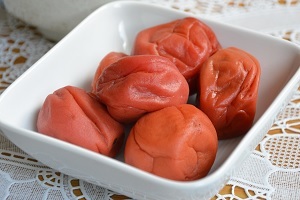
Umeboshi is a pickle of ume (Japanese plum) fruit, and is the pickles which is consumed the most.
It is red and tastes very salty and extremely sour.
Foreign tourists might have mixed feelings about its intense sourness.
Ume is translated as "Japanese plum" in English.
It is a kind of fruit-bearing tree.
Ume blooms beautifully in early spring and bears fruit in early summer.
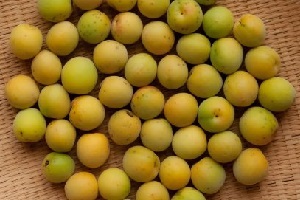
Fully-ripened ume fruits for umeboshi
The fully-ripened ume fruits are packed in barrels with salt, and a weight is placed on the top.
During some days, the fruits gradually exude juices.
Then, some red perilla herbs are added in the juice, so the fruits become red.
After some weeks, the fruits are dried in the strong summer sunshine for a few days.
Those are umeboshi.
Umeboshi is usually eaten with rice.
Sometimes, one or two pieces of umeboshi are served for breakfast at ryokan.
(When you put an umeboshi on the rice, it looks like the flag of Japan.)
Umeboshi has a large seed.
When you eat umeboshi, you must remove the seed.
Wakayama Prefecture is famous as a main production center for good umeboshi.
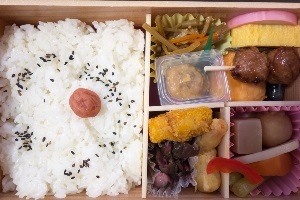
Umeboshi in Ekiben
(Lunch box sold in raiway station)
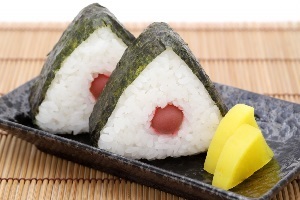
Onigiri with umeboshi
Takuan
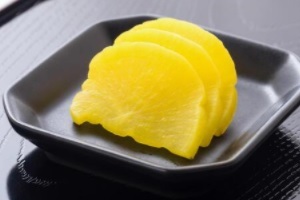
Takuan is a popular and traditional pickle in Japan.
It is made from daikon (Japanese radish), and the color is usually yellow.
Commonly sliced takuan is serve.
First, harvested daikons are hung in the sun for some weeks.
Then, they are placed in a pickling crock, covered with a mix of salt, rice bran (nuka) optionally sugar and dried persimmon peels.
And a weight is placed on top of the crock.
Generally, "kuchinashi" (common gardenia), which is a kind of asian flowers, is added and it makes daikon yellow.
Asa-zuke
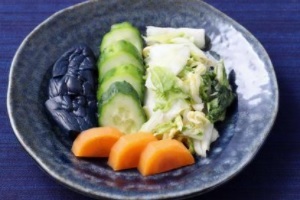
Asa-zuke is a pickle that it is easy to make at home.
After rubbing chopped vegetables with salt, it is made by pickled them with chopped konbu or red pepper in a container for half a day to a full day.
As the ingredient of asa-zuke, hakusai (Chinese cabbage), cabbage, eggplant, cucumber, turnip, carrot, etc. are used.
restaurant set meals usually come with pickles.
Often, the restaurant itself serves homemade pickles.
Nozawana-zuke
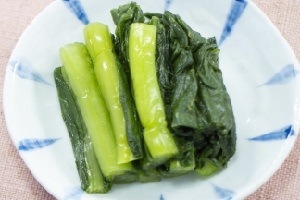
Nozawana-zuke is the pickle of a leaf vegetable.
Nozawana is one of a Japanese variety of mustard leaf.
It is harvested in the highland of Nagano area and the central area is Nozawa Onsen Village, popular for its hot springs and ski resorts.
The harvested leaves and stems are packed in barrels with salt.
Because it is made in cool area and ferments slowly, the taste is mild.
It is a popular pickle, and you can find even in Tokyo area.
Nara-zuke
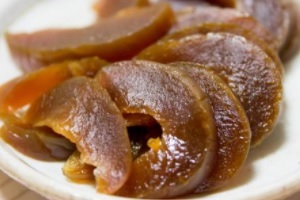
Nara-zuke is a pickle of "Shirouri" which is translated as Oriental pickling melon in English, or cucumber.
It is said that this pickle was created in Nara city in the 8th century.
The ingredients are packed in barrels with salt, then a weight is placed on the top.
So the liquid of the ingredients is exuded.
After that, they are covered with sake lees and sugar.
It is pickled and aged for several months, and the pickle becomes tortoiseshell color.
Because it is pickled in sake lees, this pickle contains alcohol.
Eating this may cause people with a low tolerance for alcohol to get drunk, so please be careful.
Fukujin-zuke
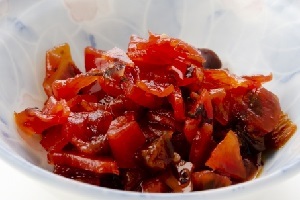
Fukujin-zuke is also popular kinds of pickles, and commomly used as a garnish for Japanese curry.
Seven kinds of vegetables including daikon, eggplant, lotus root and cucumber are chopped, then pickled in a base that flavored with shoyu and mirin.
So it has salty-sweet taste.
And it is colored red or orange with color additive.
"Fukujin" means Seven Lucky Gods.
It comes from using seven different kinds of vegetables.
Senmai-zuke
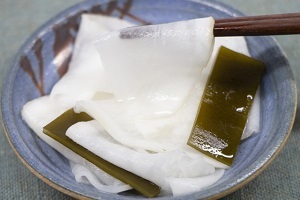
Senmai-zuke is the pickle of a thin-sliced turnip.
It is one of popular pickles of Kyoto.
The turnip harvested around Kyoto is sliced very thinly, and they are pickled in vinegar with Konbu and red pepper.
This is made in winter.
So, this is sold in souvenir shops in Kyoto from October until around March or April.
Gari
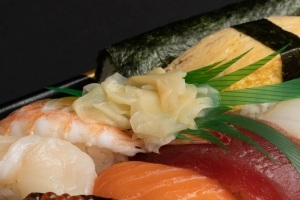
Gari is thinly sliced ginger pickled in sweet vinegar.
It is ivory or light pink in color.
Gari is mainly served with sushi.
It is always included in takeout sushi packs, and when you sit at the counter in a sushi restaurant, it is usually placed in front of you first.
Gari serves to refresh your palate after eating a piece of sushi.
Beni-shoga
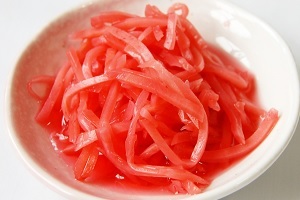
Beni-shoga
Beni-shoga is also a pickles of ginger.
"Beni" means red, and "shoga" means ginger.
It is made by thinly slicing ginger and pickling it in vinegar that has been dyed red with red perilla leaves or other ingredients.
So It is a vibrant red color.
Beni-shoga is often topped on gyudon, yaki-soba (fried Chinese noodle).
And, chopped beni-shoga is mixed into okonomiyaki and takoyaki.
It is often used as a topping for slightly greasy Japanese dishes.
Rakkyo
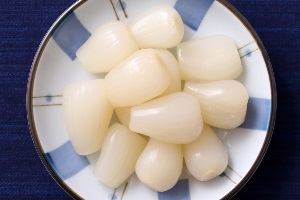
Rakkyo is a white bulb of vegetable like shallot.
It is harvested in Japan and China.
It is related to garlic and onions, and have a similar taste and crunchy texture.
Commonly it is made by pickling in vinegar and sugar.
Rakkyo is harvested around early summer, and the pickles are also made at home.
However, many of these are produced in factories and can be eaten all year round.
It is a popular side dish for curry and rice. You can find it at a curry specialty restaurant.