
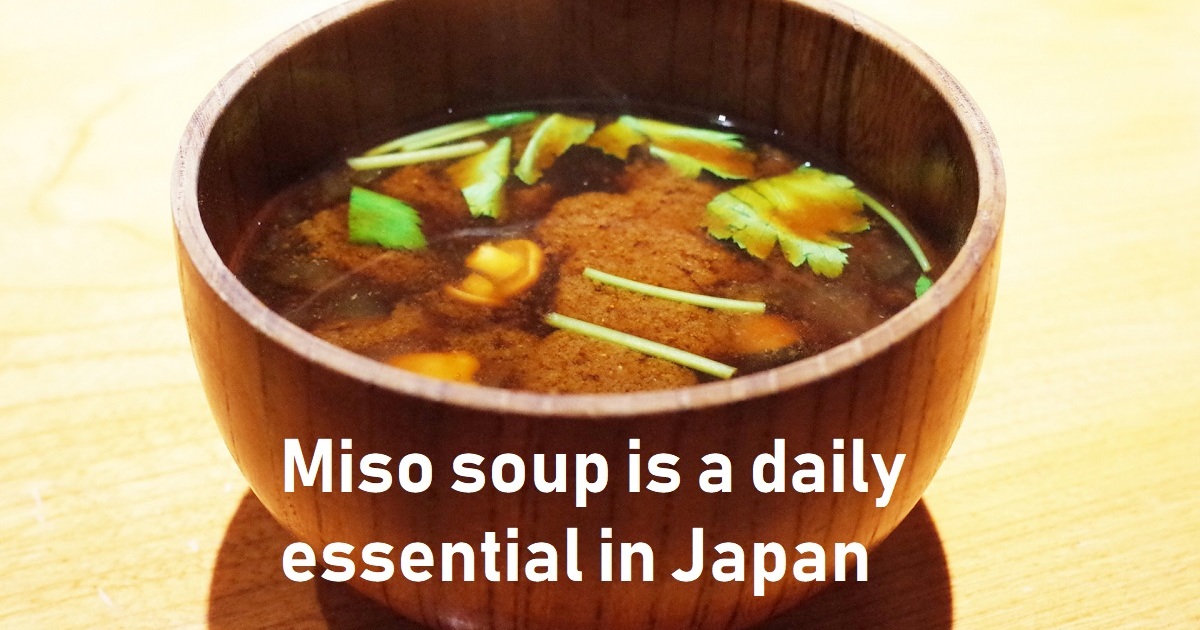
Various Japanese soup (Miso soup, Suimono, etc.)
Miso soup
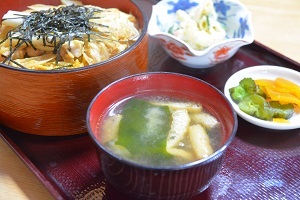
Misoshiru in a Japanese meal
Miso soup is a daily essential in Japan.
It is called Misoshiru in Japanese.
Miso soup is made by mixing miso with dashi (Japanese broth).
And a few kind of foods are added in it.
Added foods are generally tofu, abura-age, fu, wakame, green onion, hakusai, spinach, daikon and other vegetables.
Additionally mashrooms, shells, egg and so on are commonly used.
Usually, one or two kinds among these foods are used.
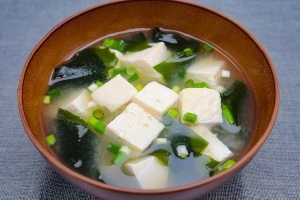
Misoshiru of tofu and wakame
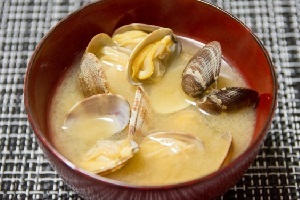
Misoshiru of clam
There are two main types of miso.
They are shiro-miso (white miso) and aka-miso (red miso).
Shiro-miso soup is cooked in many case, but also there are some areas where aka-miso soup is mainly cooked. (For example, Nagoya area and Kyoto area)
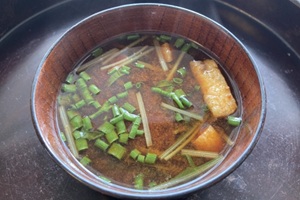
Aka-dashi
Aka-miso soup is called Aka-dashi, and it has saltier and thicker taste than shiro-miso soup.
Miso has the flavor of fermented food and dashi has the flavor of fish.
Therefore, some foreigners may dislike miso soup.
Miso soup is inseparably related to the Japanese meal.
In restaurant and hotel, miso soup is usually served in a set of the meal.
In Japan, miso soup is positioned as a dish eating with rice.
So, it is served with main dish from the beginning of the meal.
You can eat it whenever you like during the meal.
Other various Japanese soup
Suimono
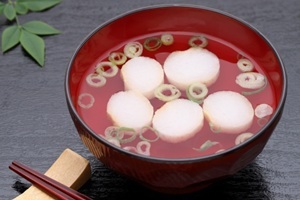
Suimono
Suimono is the clear soup without miso.
As the polite word, it is called Osuimono.
Suimono is made with only dashi soup and salt.
Therefore, it is very important to use high-quality and tasty dashi.
The taste is sophisticated, so it is mainly served on auspicious occasions.
Since the main feature of Suimono is its delicious dashi broth, it contains fewer ingredients compared to miso soup.
Because the broth of soup is clear, the ingredients are chosen to be visually appealing.
Tonjiru
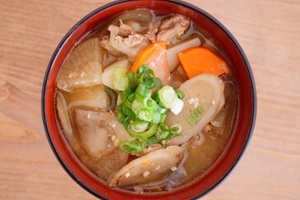
Tonjiru
Tonjiru means pork soup.
Sliced pork is added to miso soup.
In addition, konnyaku and various vegetables such as gobo (burdock), satoimo (Japanese taro), carrot, etc. are added.
Pork and many foods are in the soup, so this is served not only as soup but also as one of main dish.
Kenchinjiru
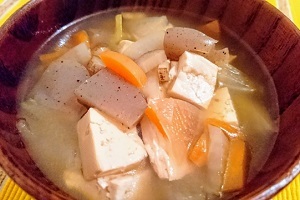
Kenchinjiru
Kenchinjiru is also a soup with many foods.
Tofu, kon-nyaku, daikon, carrot, burdock and sato-imo (Japanese taro) are fried with sesame oil, and they are boiled in the soup of dashi, shoyu and salt.
This is the soup without miso.
And a feature is the addition of sesame oil flavor to the soup.
Kenchinjiru was originally a Buddhist vegetarian dish.
Ushiojiru
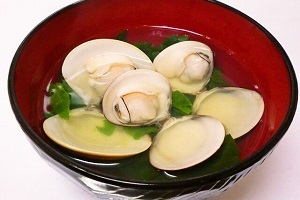
Ushiojiru
Ushiojiru is very simple clear soup, and it is a kind of Suimono.
It is made by boiling fresh fish in water and adding a little salt.
As the ingredients, white fish with a mild flavor such as sea bream and sea bass, and Asian hard clams are commonly used among shellfish.
We can taste the pure flavor of the ingredient.
Shellfish is cooked in the shells, so you use chopsticks to remove the meat from the shell in the bowl before eating.
Dobin-mushi
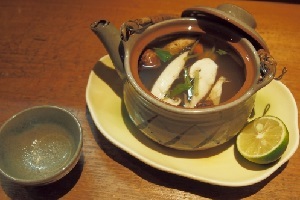
Matsutake Dobin-Mushi
Dobin-mushi is a dish that several ingredients are placed in a ceramic teapot called "dobin", and hot dashi broth is poured into it.
"Mushi" means to steam, so the dobin is steamed and warmed before being served to the guests.
Matsutake mushrooms are expensive, high-end Japanese mushrooms that are harvested in small quantities only in the autumn.
Dobin-mushi is a refined way to savor the aroma of matsutake mushrooms in a soup.