
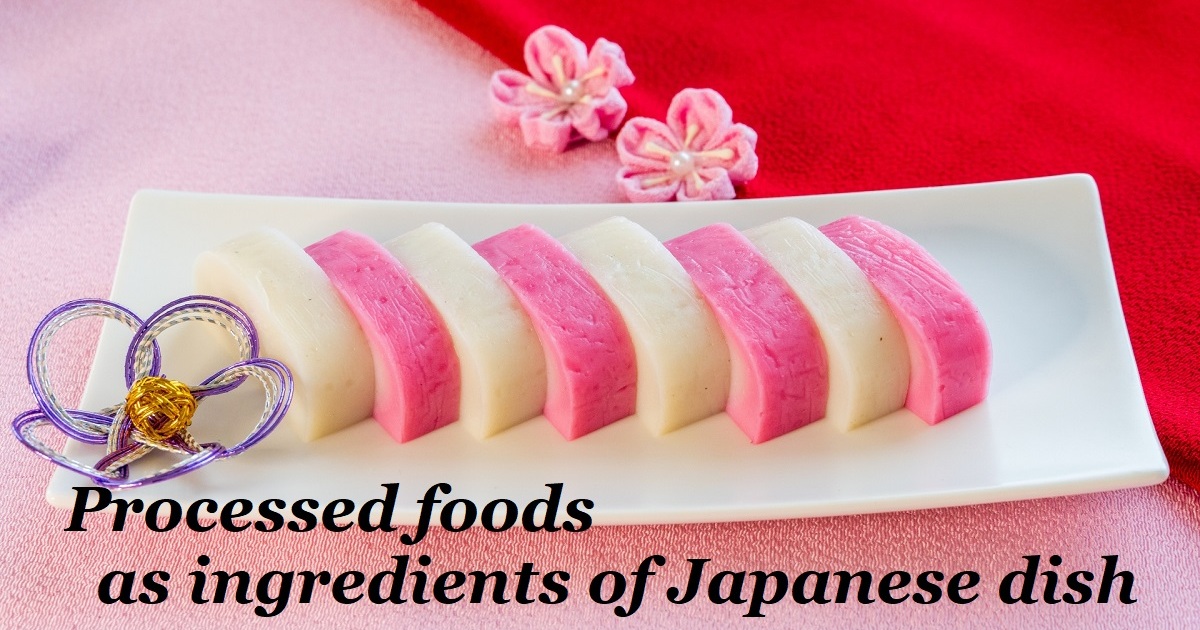
Processed foods as ingredients of Japanese dish
Tofu & its related foods Processed foods of vegetables Processed foods of fish
Tofu and its related foods
Tofu is the food which east Asian people eat, and is one of the most important ingredients in Japanese dishes.
Recently it becomes known to the world as one of healthy foods.
It is white, soft, and easily deformed food.
And it has a very delicate flavor of soy bean.
Tofu is made by boiling broken soy beans and coagulating the liquid with bittern (An additive including much magnesium chloride from seawater).
Commonly, tofu is produced in a square mold.
So it is sold in the square shape.
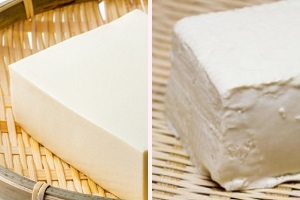
Kinu-tofu (left), Momen-tofu (right)
There are two types of tofu on the market.
One is soft tofu.
It is called Kinu-tofu (or "Kinigoshi-tofu") in Japanese, and the meaning is tofu of silk.
It is very smooth and delicate like silk cloth.
Another is firm tofu.
It is called Momen-tofu in Japanese, and the meaning is tofu of cotton.
When making tofu, cotton cloth is actually used.
They are used according to the type of cooking and the cook's favorite.
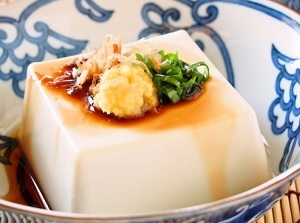
Hiya-yakko
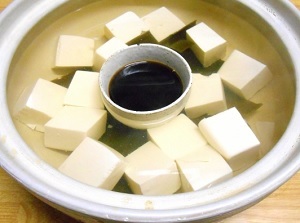
Yudofu
It is a simple dish to pour soy sauce on a tofu.
It is called Hiya-yakko.
And the dish boiling and eating tofu in a pot is Yudofu which is one of popular dishes in Kyoto.
Of course, tofu is used for the other various Japanese dishes.
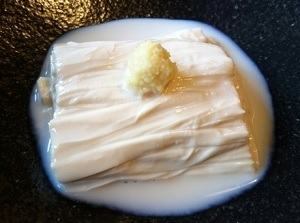
Yuba
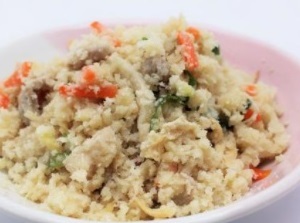
Dish of Okara & vegetable
The liquid during making tofu is called tonyu (Soymilk) and it is one of the healthy drink.
When tonyu is boiled, a film is formed on the surface.
This is Yuba and is often used to cook the vegetarian dish.
Yuba in Kyoto and Nikko is well-known.
The leftover that tonyu is squeezed is Okara.
It is rich in nutrients and is used for the ingredient of the healthy dish.
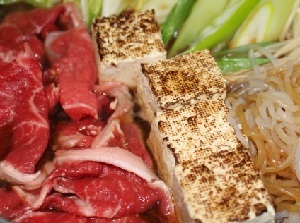
Yakidofu
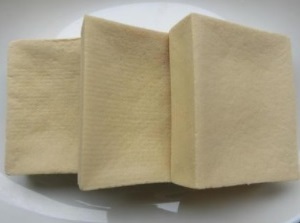
Koyadofu
There are some foods processed from tofu.
These are also used for various Japanese dishes.
Yakidofu is the tofu that the surface has been burned.
It is often used in Sukiyaki.
Koyadofu is made by freezing and drying sliced tofu in cold air.
The texture is like sponge.
"Koya" means Koyasan.
Koyasan is one of sacred places in Japanese Buddhism.
It was invented by the priests of Koyasan.
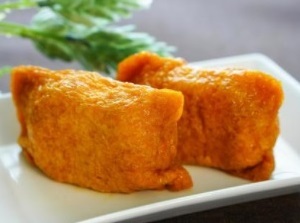
Sushi wrapped with Abura-age
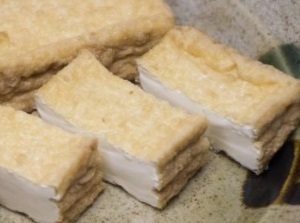
Atsu-age
Some fried products by oil are popular.
They are used for various Japanese dishes.
Abura-age is thinly-sliced and fried tofu.
It is often called "Age" simply.
Atsu-age is thicker-sliced and fried tofu.
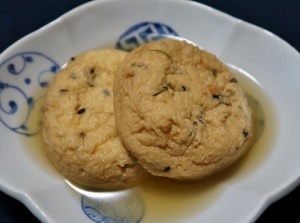
Ganmodoki
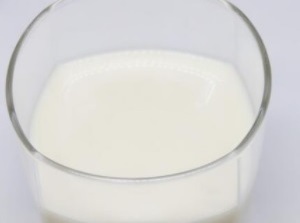
Tonyu
Ganmodoki is round fried tofu.
Commonly, chopped vegetables are mixed in the tofu.
As above, the liquid in the process of producing tofu is called tonyu (Soymilk).
It is one of the healthy drinks.
Processed foods of vegetables
Natto
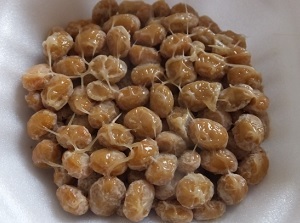
Natto
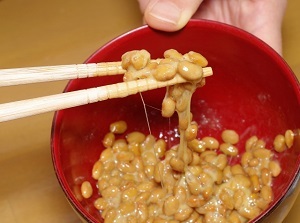
Stirred Natto
Natto is a fermented food of soybeans and is one of healthy Japanese foods.
It is made by boiling soybeans, putting them into a wrapper made of rice straw and keeping warm.
Much "Natto bacteria" live in the rice straw, and they work to make natto in the wrapper.
It has a smell like strong cheese, and it produces many spiderweb-like strings by stirring.
Probably this may be one of the foods that foreigners can't eat.
This is originally the foods in eastern Japan, but recently it is eaten across the country.
(Of course, many people in western Japan still dislike natto.)
Natto is often served for breakfast at ryokan or minshuku.
And it is used for one of the toppings of sushi.
Konnyaku
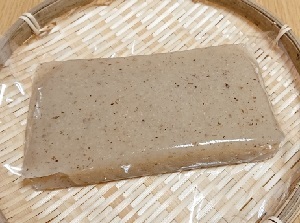
Konnyaku
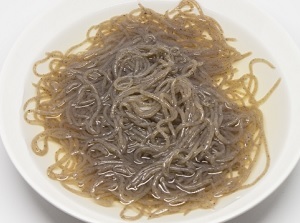
Ito-konnyaku
Konnyaku is an oddish food like gray jelly.
It is eaten only in Japan in the world.
(In Japanese, the word is pronounced as "kon"-"nyaku".)
Konnyaku is an araceous plant.
Konnyaku as food is made by grinding its corm into powder, kneading it with water and jellifying with limewater.
It has very little flavor, nutrients and calories, but it is rich in dietary fiber.
Therefore, it is the best food to eat on a diet.
The texture is like a hard jelly.
Japanese people have eaten such unique food since ancient times.
Generally, it is eaten by boiling with dashi and shoyu.
And it is used for various Japanese dishes.
Shirataki is the kon-nyaku in the form of noodle.
In western Japan, it is called as Ito-konnyaku (Stringlike konnyaku).
Shirataki is often added as one of the ingredients of Sukiyaki.
Fu
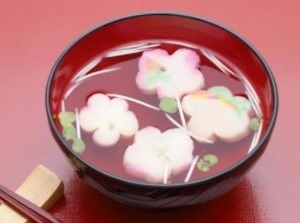
Fu in Suimono
Fu is dried bread-like piece of wheat gluten.
It was originally an ingredient used in Buddhist vegetarian cuisine.
They are made in various sizes and shapes according to the use.
The most common way is floating them in Japanese soup like an accessory.
They are shaped like flowers or traditional Japanese temari balls, and are beautifully colored.
Kanpyo
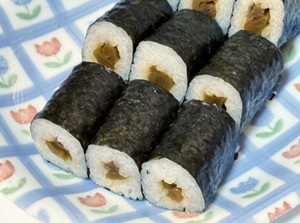
Kanpyo roll
Kanpyo is dried gourd shaving.
It is generally cooked by boiling in dashi, shoyu and sugar.
The cooked kanpyo is a flat, brown, string-like food.
It doesn't have a particularly distinctive flavor, but it absorbs seasonings well and has a pleasantly chewy texture.
It will never be the star of the dish.
But, it is often used as one of the ingredients in sushi roll.
Tororo-Konbu, Oboro-Konbu
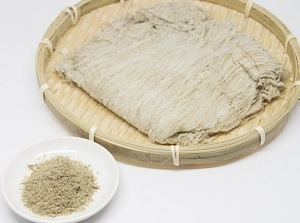
Tororo-Konbu
Tororo-Konbu and Oboro-Konbu are the products that dried Konbu after soaking in vinegar are shaved very thinly.
Tororo-Konbu is shaved like string, and Oboro-Konbu is shaved like sheet.
It feels very soft like cotton.
Because it is made with konbu, you can directly taste the base flavor of Japanese cuisine.
They are used for wrapping Onigiri (rice ball) or putting in Japanese soup.
Shio-Konbu
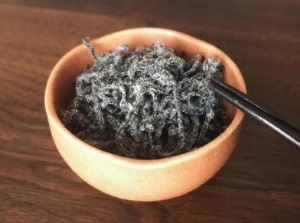
Shio-Konbu
Shio-Konbu is a product of konbu, and is also called "Shiofuki-konbu".
"Shio" means "salt".
Konbu is cut into small pieces and they are boiled with shoyu (soy sauce) and sugar, and salt is sprinkled.
You can directly taste konbu, the base of the flavor in Japanese cuisine.
Boiled rice with shio-konbu is tasty.
And shio-konbu is used as a seasoned ingredient.
Processed foods of fish
Fish is important ingredient.
There are various processed foods of fish.
Generally, they are made from white-fleshed fish.
Kneaded flesh of whitefish is called surimi in Japanese.
The processed foods are made by forming, and steaming or broiling.
Kamaboko
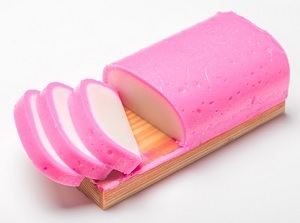
Kamaboko
Kamaboko is the food that surimi is put on a wooden board and is steamed.
Of course, we can't eat the board and we eat only steamed surimi on the board by slicing.
They have the shape of half moon.
Kamaboko can be eaten raw, like sashimi.
It can also be used as an ingredient in various dishes.
And, it is served as one of the toppings for udon or soba noodles.
Naruto
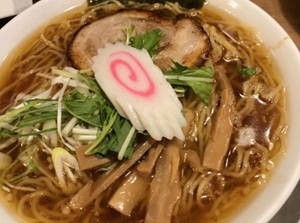
Naruto on Ramen
Naruto or Narutomaki is similar to Kamaboko.
Surimi is rolled up in a bamboo mat and then steamed to make it.
So, the edges have a jagged shape due to the use of a bamboo mat.
It is said that the name Naruto comes from Naruto City in Shikoku island, which is famous for its whirlpools in the strait.
Inspired by whirlpools, the cut surface shows a spiral pattern.
It is used as a decorative ingredient and is often used as a topping for Japanese noodles and ramen.
Chikuwa
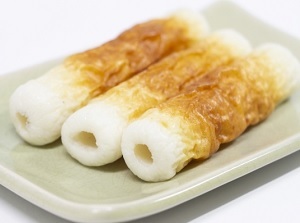
Chikuwa
Chikuwa is the tube-like food made from surimi.
It is made by wrapping surimi around a bamboo or metal stick and broiling it.
Generally, the products are removed the bamboo or stick.
So it has the form of tube.
Some products have cheese or burdock root stuffed into the holes of a tube.
Hanpen
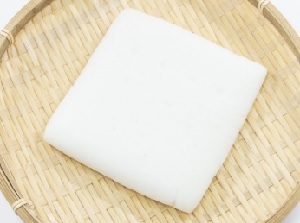
Hanpen
Hanpen is a white surimi product with square shape.
It is made by mixing grated naga-imo (Japanese yam) with surimi.
So, it is soft and has mild taste.
It is eaten raw or grilled.
And, it can be eaten by making a cut in it and putting other ingredients inside, like a sandwich.
Crab stick
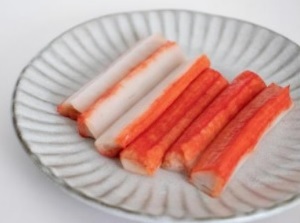
Kani-Kamaboko
Crab stick is the surimi product resembled meat of crab legs.
In Japanese, it is called as "Kani-Kamaboko" (Kamaboko of crab), and its abbreviation is "Kani-kama".
It surely taste and has a texture like crab, but it contains no crab.
Of course, it is very cheaper than real crab.
In 1973, this was invented for the first time by a seafood maker in Hokuriku region, and became a big hit in Japan.
I hear that recently this is eaten in the world as a topping on salads or sandwiches.
Satsuma-age
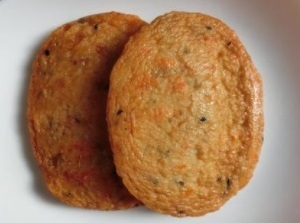
Satsuma-age
Satsuma-age is the fried surimi cake.
Satsuma is the old name of west part of Kagoshima prefecture.
The products in this area are well-known.
But same products are produced all over the country.
So you can eat them everywhere in Japan.
Himono (Dried fish)
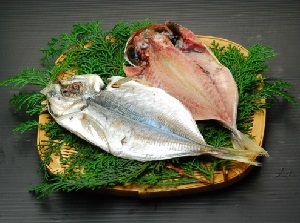
Himono of Aji
Himono is the common food that a fish is butterflied after gutting and is dried in the sun.
It is a preserved food in a short period.
It is served after grilled over a fire.
We separate the flesh from the bone with chopsticks and eat it.
If you stay in Japanese-style ryokan or minshuku, it is often served as a dish of breakfast.