
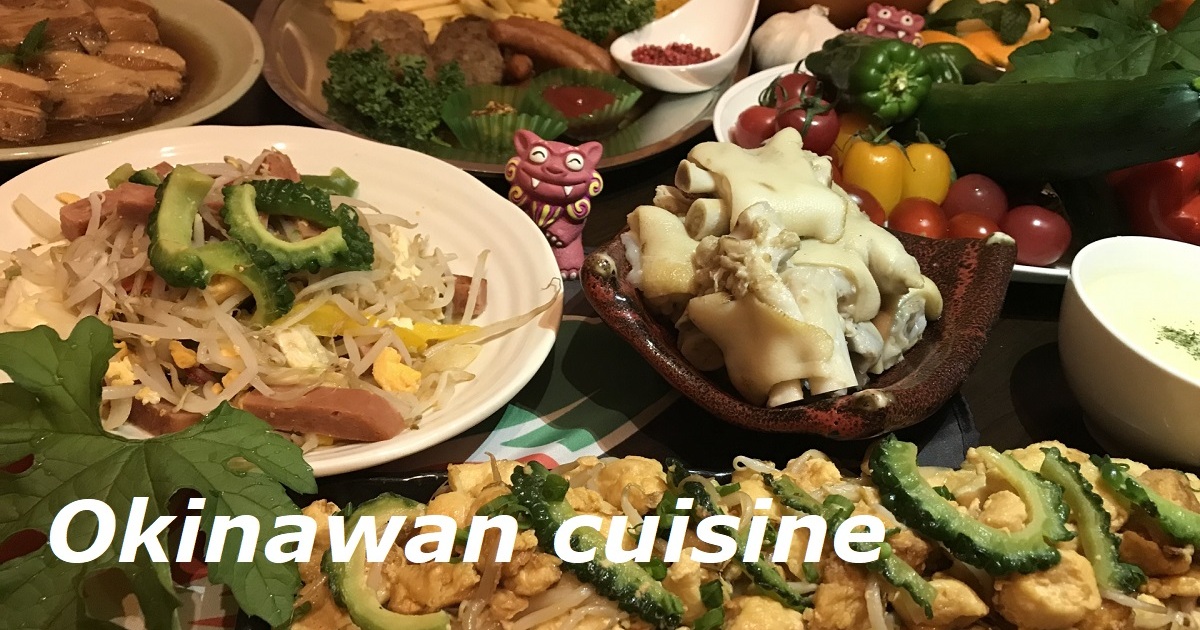
Okinawan cuisine
Dishes using pork
Dishes using pork are important Okinawan cuisine.
All parts of a pig are used for them.
Except flavor of spices, Okinawan dishes of pork may be almost same as Taiwan cuisine.
However, it is generally made by stewing for a long time and removing surplus fat.
So it is not so greasy as you think.
Rafute
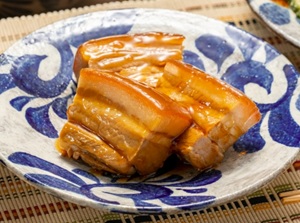
Rafute is a boiled pork dish.
(The final "e" of the word is pronounced as a long vowel like "rafutē".)
First, large cubes of pork belly are boiled to remove excess fat.
After that, these are stewed in a shoyu, dashi, sugar and awamori-based mixture.
Awamori is a distilled alcohol brewing in Okinawa.
It is the most famous Okinawan pork dish, and is served at the meat of new year or Buddhist service in Okinawa.
Soki
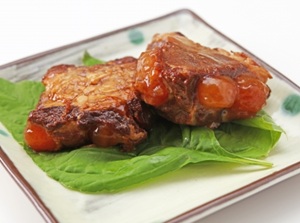
Soki is a boiled pork spare ribs with the cartilage still attached.
("O" of the word is pronounced as a long vowel like "sōki".)
Like rafute, these are stewed in a shoyu, dashi, sugar and awamori-based mixture.
Okinawan noodle topped with Soki is known as "Soki-soba" and are a signature Okinawan noodle dish.
Tebichi
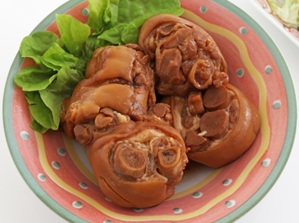
Tebichi is dish boiled pig's feet.
It is also stewed in a shoyu, dashi, sugar and awamori-based mixture like rafutee.
By simmering for a long time, the meat falls effortlessly off the bone and the skin and cartilage transform into a tender, gelatinous texture.
Tebichi contains much collagen, so they say that it is good for health.
Mimiga
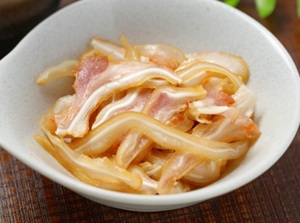
Mimiga is a boiled ear skin of pig.
(The final "a" of the word is pronounced as a long vowel like "mimigā".)
First, the hair growing on the surface of the pig's ear is burned off.
It is boiled or steamed.
It is served after cutting into strips.
It is crunchy and it also conrains much collagen.
Nakamijiru
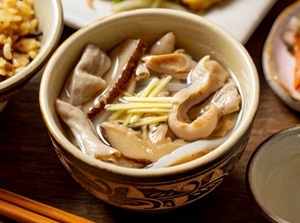
Nakamijiru is a clear soup containing pig's offal.
"Nakami" means offal, and "jiru(shiru)" means soup.
The pig's stomach and intestines are boiled for a long time to remove any unpleasant odor.
Then, they are simmered in a soup made from dashi and a little shoyu, shiitake mushroom.
This is one of the celebratory dishes served during the New Year in Okinawa.
Suchika
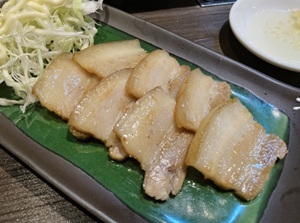
Suchika is salt-cured pork belly.
("U" and "a" of the word are pronounced as long vowels like "Sūchikā".)
Salt is rubbed all over the raw pork belly.
At that time, using mineral-rich Okinawan sea salt is particularly recommended.
The meat is wrapped with plastic wrap and is aged in the refrigerator for about a week.
It is soaked in water to remove the salt, and then boiled in a pot.
It is thinly sliced and served.
Vegetable and tofu dishes
Fried or stewed many vegetables are most popular dishes in Okinawa.
Unique vegetables in Okinawa are used, and harder tofu than mainland is also used.
Chanpuru
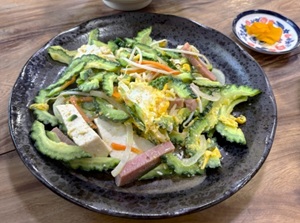
Goya-Chanpuru
Chanpuru is the most popular fried dish that some kind of vegetables and hard tofu are mixed.
(The final "u" of the word is pronounced as a long vowel like "chanpurū".)
As for vegetables, using "Goya" which is unique to Okinawa is popular.
(Goya is pronounced with both vowels long like "gōyā".)
"Goya" is called "bitter melon" in English, and the skin is edible but has a bitter taste.
In addition, firm Okinawan tofu, eggs, and pork are used.
Instead of pork, American luncheon meat "SPAM" is often used.
Nbushi
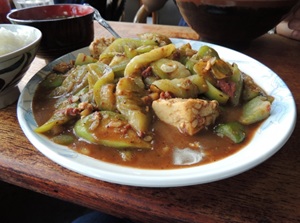
Naabeeraa-Nbushi
Nbushi is also basically fried dish.
Juicy vegetables are stir-fried together with firm Okinawan tofu and pork.
As the vegitable, loofah (called "naabeeraa" in Okinawa), winter melon (called "shibui" in Okinawa), goya are popular.
As these vegetables are being stir-fried, they release the water.
The ingredients turn out like a simmered dish, so miso or soy sauce is added for seasoning.
Irichi
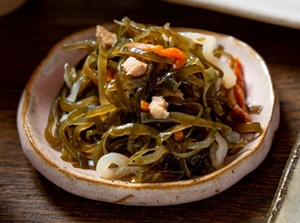
Irichi is also fried dish.
The chopped ingredients are stir-fried, and the dashi stock is added little by little.
The ingredients are simmered down until the dashi evaporates.
As for ingredients, a combination of vegetables, pork, and uniquely Japanese processed foods such as kamaboko and konnyaku is used.
The most popular version of irichi is made using shredded "konbu" (kelp) which is essential to Japanese cuisine.
Umi-budo
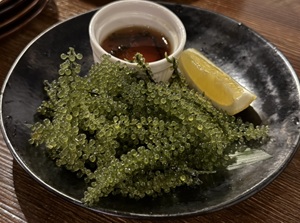
Umi-budo is a type of seaweed harvested from the waters around Okinawa.
"Umi" means "sea" and "budo" means "grape".
Its stem has a lot of grains like green beads.
From the shape, it is called "sea grape" or "green caviar" in English.
But, this is not fruit but seaweed.
It is eaten raw or used as a topping for cold dishes.
It seems that the people in Okinawa do not eat this very often and it is served to visitors to Okinawa.
Other popular Okinawan dishes
Okinawa soba
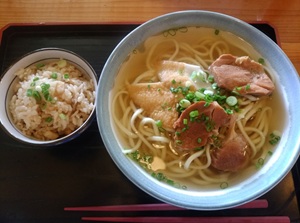
Set menu of Okinawa soba
Okinawa soba is the noodle of Okinawa.
It is named "soba", but it is different from one of mainland.
The noodles are made using wheat flour.
During the production process, "Kansui" (alkaline mineral water) is used like ramen noodles.
But the noodle is thick and not yellow, so it is rather similar to "udon".
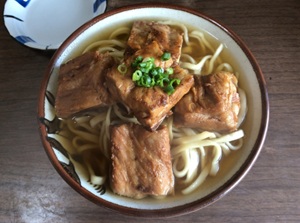
Soki soba
Okinawa soba is made by boiling the noodle and putting into hot soup flavored with Japanese dashi and pork.
Standard toppings are sliced pork belly, chopped green onion.
Sometimes, sliced kamaboko (fish cake), beni-shoga (red pickled ginger), etc. are added.
There is also a version of Okinawa soba topped with "Soki" instead of pork belly.
It is called Soki soba.
Taco rice
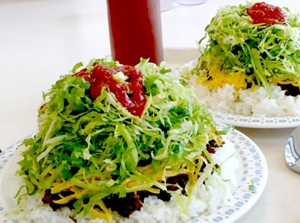
Taco rice is the dish that taco, which is a traditional Mexican dish, is served on a bed of rice.
Genarally taco meat (seasoned ground beef), shredded lettuce, tomato, cheese are added.
In 1984, Taco rice was invented by a restaurant near the U.S. Marine Corps stationed at Camp Hansen in the central part of Okinawa Island as a cheap and delicious dish for the U.S. soldiers.
The dish quickly became popular and spread throughout Okinawa.
There are many specialty shops for taco rice in Okinawa Prefecture, and you can also enjoy it at the cafes and the restaurants.