
Japanese noodles (Udon, Soba, etc.)
Udon and Soba
Eating udon
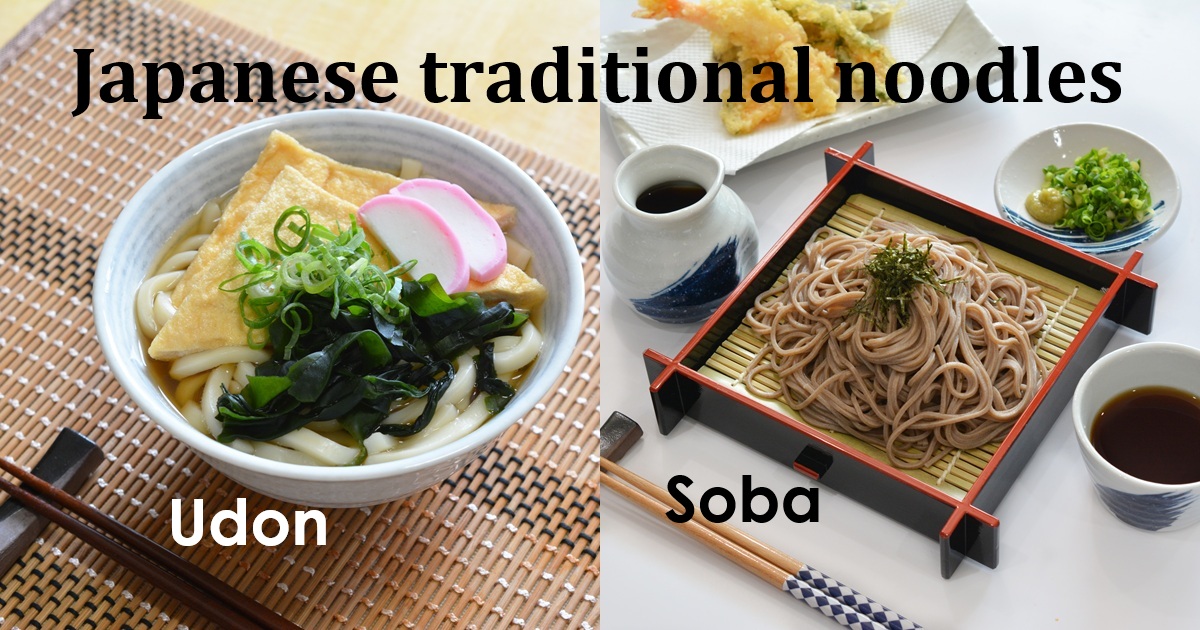
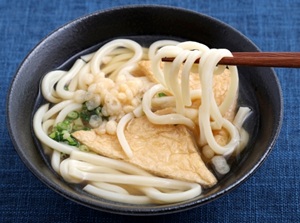
Udon is a noodle made of plain wheat flour.
It is white noodle like spaghetti, but it is thicker and softer than spaghetti.
Generally, Udon noodles tend to be more popular in western Japan.
Udon noodles are produced throughout Japan, taking advantage of the local climate and materials.
Among them, there is one that is known as a famous local product.
Sanuki udon is a specialty product of Kagawa Prefecture in Shikoku island.
It has strong chewiness and elasticity, as well as its smooth, slippery texture.
Inaniwa udon is a specialty product of Akita Prefecture in Tohoku region.
It is very thin, with a smooth, slippery texture and a firm, chewy bite.
Eating Mori-soba
Soba is a noodle made of buckwheat flour.
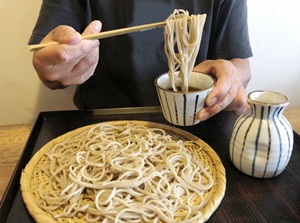
It is gray noodle and the thickness is about 1.5 to 2 milimeters.
It is harder than udon.
Buckwheat was a famine relief crop and has been cultivated in cool regions and mountainous areas where rice harvesting is difficult.
Unlike the more widely known udon noodles, soba noodles are a local specialty that can be enjoyed in specific regions.
We can eat both noodle everywhere in Japan.
Most noodle restaurants serve both.
There are also specialty restaurants serving udon or soba noodles.
Generally, Udon noodles tend to be more popular in western Japan, while Soba noodles tend to be more popular in eastern Japan.
Three types of the dishes of Udon and Soba
Kake (Hot noodle)
Kake-udon
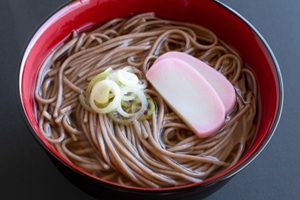
Kake-soba
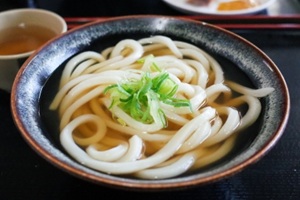
Udon or soba noodles are boiled in hot water and placed in a bowl.
Then, a broth made from dashi and soy sauce is poured over them.
Chopped green onions are added as a condiment.
"Pour" in English is the Japanese verb "kakeru", so this type of dishes are called Kake-udon, Kake-soba.
This is the simplest and most basic form of dish.
The broth is thick in eastern Japan including Tokyo.
But, it is based on light-colored and tasty dashi in western Japan including Osaka, Kyoto.
There are menu items that various toppings are added to Kake-udon, Kake-soba.
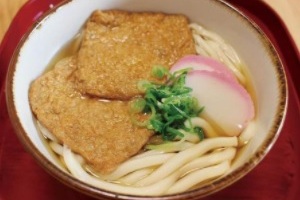
Kitsune-udon
Kitsune-udon/soba
It is topped with "Age" which is deep-fried tofu simmered in a sweet and savory sauce made with dashi, soy sauce, and mirin.
"Kitsune" means "fox".
Kitsune is a messenger of the gods of Inari shrines, and loves "Age".tofu.
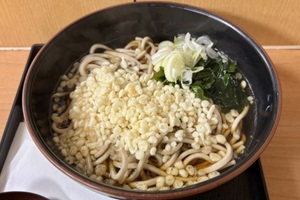
Tanuki-soba
Tanuki-udon/soba
It is topped with "Tenkasu" which is a collection of small pieces of batter that scattered when Tenpura was fried.
"Tanuki" means "raccoon dog".
In Japanese folklore, foxes and raccoon dogss are classic examples of animals that deceive humans.
It is said that this popular topping has been named "tanuki" to rival "kitsune".
Tenpura-udon/soba
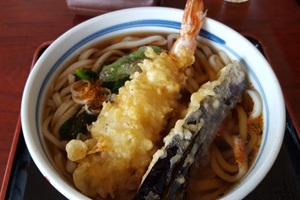
Tenpura-udon
It is topped with "Tenpura" which is a traditional Japanese dish in which ingredients such as seafood and vegetables are coated in a batter of flour, egg, and water, and then deep-fried.
Tanuki-udon or soba is a dish topped with fried tempura batter scraps, but tempura-udon or soba is topped with several pieces of genuine tempura.
Shrimp is the most popular ingredient for tempura, but other vegetables and processed foods such as "Chikuwa" (fish cake) are also used.
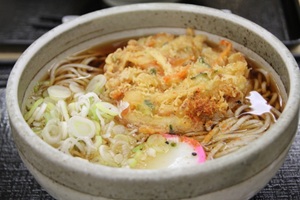
Kakiage-soba
"Kakiage" is a tenpura made by mixing finely chopped vegetables and seafood and deep-frying them in tempura batter.
This is also one of popular toppings.
The broth used for udon and soba noodles is similar to the broth used for tenpura, so the noodles topped with tempura go very well with them.
Curry-udon/soba
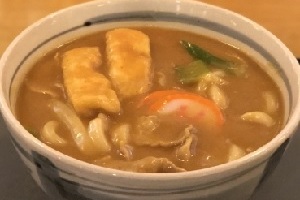
Curry-udon
Curry-udon/soba is made by mixing curry roux into the broth.
Curry rice was introduced to Japan in modern times, and now it has become one of the favorite dishes of Japanese people of all ages.
This is an application of that curry flavor to traditional udon and soba noodles.
Many foreign tourists are surprised by the fusion of curry with udon or soba noodles, but it is said that many are impressed by its delicious taste.
Tsukimi-udon/soba
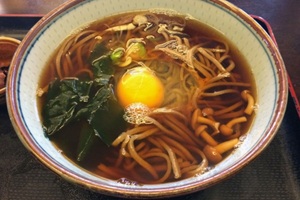
Tsukimi-soba
Tsukimi-udon/soba is simply the noodles topped with a raw egg.
Tsukimi means "to view the moon," and it is an elegant name because the round and yellow raw egg on top of noodles resembles a full moon.
Of course, you can eat the raw egg however you like.
If you break the yolk, it will mix into the noodles and soup, creating a delicious and mild flavor.
But, many foreigners are not accustomed to eating raw eggs, so this dish is often avoided.
Mori (Cold noodle)
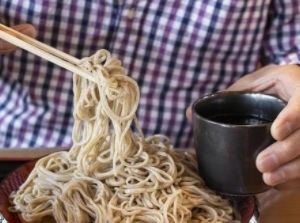
Mori-soba
Udon or soba noodles are boiled in hot water.
Then, the boiled noodles are quickly cooled in water.
The noodles are served on a bamboo strainer in a tray.
A small cup is provided with a rich broth made from dashi, soy sauce, and mirin.
You pick up the noodles with chopsticks and dip them in the broth to eat them.
To the broth in the cup, you can add chopped green onions, grated wasabi or ginger as condiments, according to your liking.
This is a completely cold dish.
In the hot and humid summer weather, Japanese people enjoy these cold noodle dishes.
The Japanese verb "moru" is used to describe the act of placing food in a dish in a mound-like shape.
The noun form is "mori", so this type of dishes are called Mori-udon, Mori-soba.
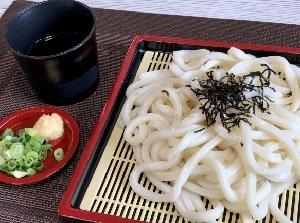
Zaru-udon
Noodles topped with shredded "Nori" seaweed are called Zaru-udon, Zaru-soba.
"Zaru" means the bamboo strainer for the noodles.
"Zaru" noodles are slightly more expensive than "Mori" noodles because it includes "Nori".
Furthermore, historically, the "zaru" (bamboo basket) has been considered slightly more prestigious than the simple "mori".
Nikomi (Stewed noodle)
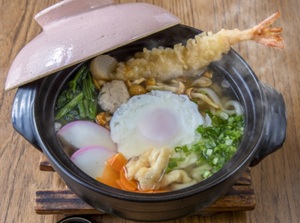
Nabeyaki-udon
The broth is poured into a ceramic bowl for one serving, and then the fresh noodles are placed inside.
Several ingredients are added as toppings, and the bowl is placed directly over the fire.
The noodles are stewed in the broth, resulting in a hot and simmering udon dish.
The Japanese word "nikomi" means stewing.
Udon noodles are suitable for this dish, and it is usually listed on the menu as Nikomi-udon.
However, there aren't many types of fresh noodles that are suitable for this cooking method.
Therefore, it is almost always prepared using regular boiled noodles.
Although it looks the same as "Nikomi-udon", this is distinguished by the name Nabeyaki-udon.
In most noodle restaurans, the dish with this name is on the menu.
It is popular during the cold winter months.
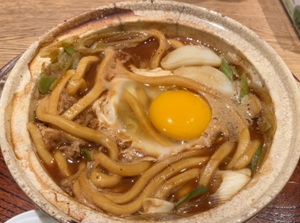
Miso-nikomi-udon in Nagoya
There is a famous local dish that is made using the formal "nikomi" cooking method in Aichi Prefecture in Tokai region.
It is "Miso-nikomi-udon".
This dish uses fresh noodles that are made specifically for this recipe and are slightly firm.
"Miso" is a paste made from fermented soybeans and is used as a seasoning in Japanese cuisine.
In this udon, a rich-flavored red miso, a specialty of Aichi Prefecture, is added to the broth.
The central metropolis of Nagoya has many specialty restaurants.
At the restaurant, this is served to you with the broth still bubbling.
Noodles similar to Udon
Kishimen
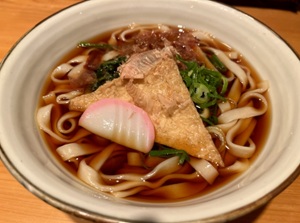
Kishimen in Nagoya
Kishimen is a type of udon noodle that is wide and thin.
The noodles are less than 2 mm thick.
Kishimen noodles are prepared in a similar way to udon noodles.
They are boiled and served with hot broth, or they are boiled, cooled in water, placed in a bowl, and then dipped in broth before eating.
Udon noodles developed in ancient times in the Kansai region, centered around Osaka, and then spread to eastern Japan.
However, this flat-shaped kishimen noodle had been made in Aichi Prefecture and it is still loved in the area centered around Nagoya.
Somen
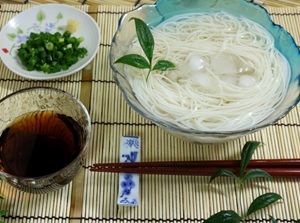
Somen
Somen is a type of udon noodle that is extremely thin.
The diameter of the noodles is stipulated to be 1.3 mm or less.
(The "o" in the word "Somen" is pronounced with a long vowel like "Sōmen.)
It is said that Somen was introduced from China in the 8th century, and it is a traditional noodle dish that has been eaten since then.
Nowadays, it is a popular refreshing noodle dish to eat in the middle of summer in Japan.
After being briefly boiled in water, it is cooled in cold water.
At the restaurant, the noodles are often served in cold water, and then you dip it in the broth in the cup and eat it.