
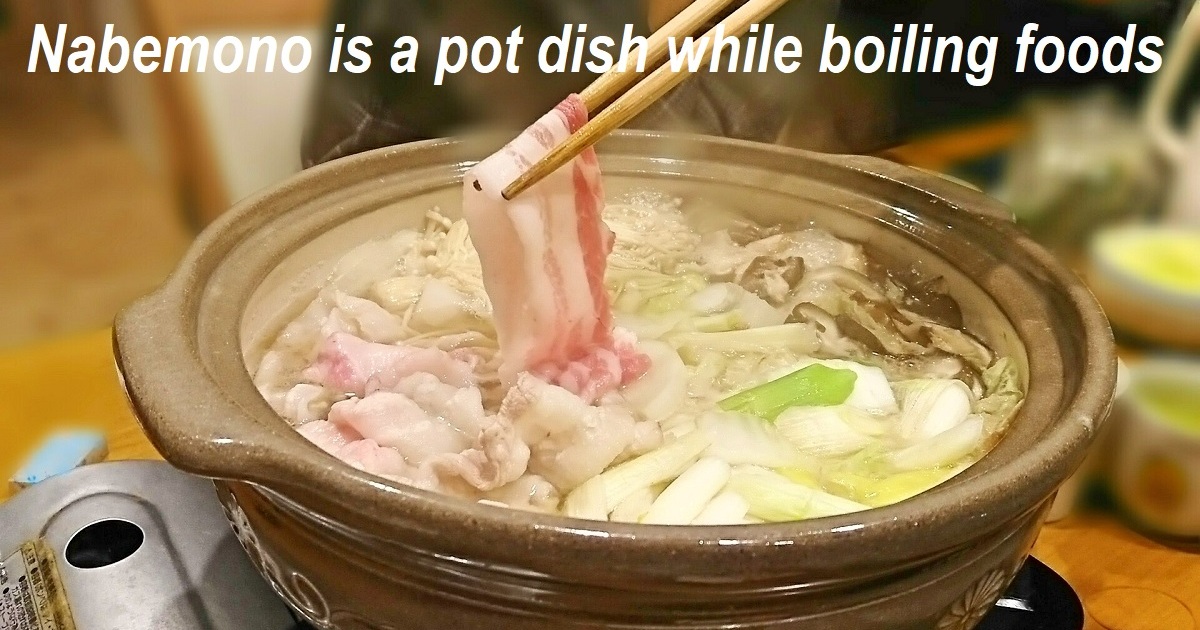
Nabemono (One-pot dish cooked at the table)
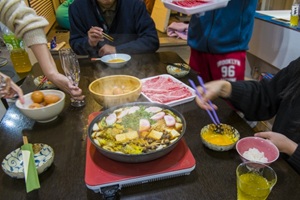
Eating sukiyaki in a group
"Nabe" means "cooking pot" and "mono" means "kinds".
A portable stove is set on the center of a table and a pot is put on it.
A few members of family or friends sit around the pot.
Various ingredients and soup are put into the pot, then a member sets fire to the stove.
The foods are gradually boiled, then become edible.
Each of the member picks some favorite foods from the pot to each plate, and eats them.
A characteristic of Nabemono is that everyone cooks it themselves and eats it together.
Very hot foods are eaten around the heated pot, so most nabemono dishes are usually served in the cold season.
In ryokan or minshuku, the meals are served individually.
A small pot and a stove are set on each individual table.
Yosenabe
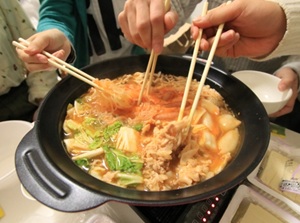
Eating Yosenabe together
Yosenabe is most common style of nabemono.
It means "one-pot dish cooked various ingredients together".
We often call it as "Nabe" shortly.
A large earthen pot called "Donabe" is used for Yosenabe.
In advance, the broth made from Japanese-style dashi seasoned with soy sauce and mirin is placed in an earthenware pot.
A portable stove is placed in the center of the table, and an earthenware pot is set upon it.
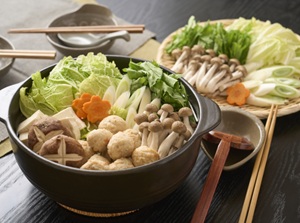
Ingredients of a Yosenabe
Various ingredients are cut into bite-sized pieces and arranged around the earthenware pot.
The ingredients to be prepared usually consist of a combination of meat or fish, several kinds of vegetables, mushrooms, and tofu.
As for vegetables, Japanese-style leafy vegitables such as Hakusai (Chinese cabbage), Naganegi (green onion), Shungiku (edible chrysanthemum) are essential.
The stove is lit, and the broth in the Donabe is brought to a boil.
The diners put all the prepared ingredients into the Donebe and simmer them.
Each member uses chopsticks to pick up the cooked ingredients, places them on their own small plate, and eats them.
The members repeat this process until the ingredients in the Donabe are eaten up, and they enjoy the meal together.
After all ingredients are eaten up, delicious soup infused with the essence of the ingredients is left in the Donabe.
We often add boiled rice or udon noodles to the soup and simmer it.
It makes delicious "Zosui" (rice porridge) or "Nikomi-udon".
This will be the final course of "Nabe party" meal.
Yosenabe is a dish that families or groups prerpare the ingredients, cook them, and eat together.
So, very few restaurants have this on their menu.
But, in terms of group dining, some izakayas (Japanese pub) offer course menus of Yosenabe during cold season.
Chanko-nabe
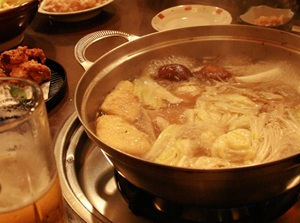
Chanko-nabe at a Chanko restaurant
Chanko-nabe is an one-pot dish that professional Sumo wrestlers eat on a daily basis.
Grand Sumo is one of the events of Japanese martial arts, and about 600 professional Sumo wrestlers currently registered.
There are 45 Sumo stables, and each wrestler belongs to one of the stables.
They are living communally as a group in each stable.
So, for the sumo wrestlers who eat vast amounts of food, the nutritious one-pot dish that are quick and easy to prepare has become a daily staple.
This is Chanko-nabe.
The method for cooking Chanko-nabe is the same as Yosenabe.
Yosenabe is based on a traditional Japanese broth, but Chanko-nabe uses a broth based on chicken bones.
For simmering large quantities of ingredients, a large metal pot is often used instead of an earthen pot (Donabe).
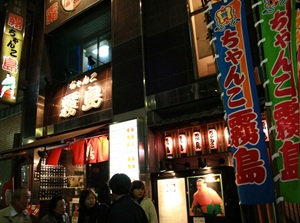
Chanko restaurant in Ryogoku
There are some restaurants specializing in Chanko-nabe opened by a retired Sumo wrestlers.
You can enjoy Chanko-nabe in the size suitable for groups to share, just like a standard Yosenabe.
In particular, there are some Chanko-nabe restaurants around the Ryogoku Kokugikan in Tokyo, the home arena of Grand Sumo.
Sukiyaki
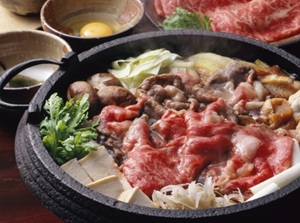
Sukiyaki is one of most famous Japanese dishes well-known in the world.
When making sukiyaki, a shallow iron pot is used.
Generally, it is made by stewing thinly-sliced beef, yakidofu (grilled tofu), shirataki (konnyaku noodle), green onion, shiitake mashroom etc. in the sweet and savory soup made by mixing dashi, soy sauce, and sugar.
A tabletop stove is placed in the center of the table, an iron pot is set on top of it, and the flame is lit.
The iron pot heats up quickly, so beef fat is melted at the bottom.
Beef and vegetables are added and the broth is poured in.
Sukiyaki is also a type of hot pot dish.
Each diner uses their chopsticks to pick up ingredients from the pot, puts them into a small plate, and eats them.
The ingredients are usually dipped in a small bowl of raw, beaten eggs, when we eat the ingredients.
Japanese eggs are subject to rigorous hygiene controls, so it is perfectly normal for Japanese people to eat them raw.
In sukiyaki, raw egg makes the sweet and salty flavor flavor of the ingredients milder, and makes the dish even more delicious.
Most foreigners are not accustomed to eating raw eggs, so this will be an experience of Japanese culture.
In major cities, there are many restaurants specializing in Wagyu (Japanese beef) dishes.
You can eat sukiyaki there.
Shabu-shabu
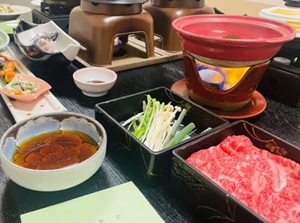
Preparing shabu-shabu in an Onsen hotel
Shabu-shabu is the dish that the diner soaks a thinly-sliced meat or fish in boiling broth in a pot with chopsticks for a few seconds and eats after dipping in favorite sauces.
The sauces are usually used "ponzu" (mixed juice of Japanese citrus fruits to shoyu and mirin), or "goma-dare" (mixed sesami paste to shoyu and mirin).
Vegetables and tofu are slaso preparated in addition.
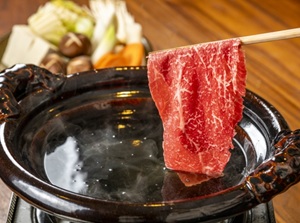
Soaking meat
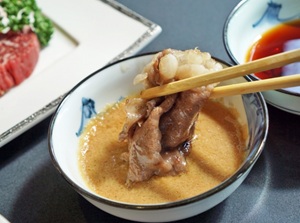
Dipping meat in goma-dare
This is a style of one-pot dish that the restaurant simply provides the ingredients and the pot and the diners cook the food themselves exactly as they like.
So, there are the cases that a group gathers around a large pot, and individual small pots are provided.
Beef or pork is used as the popular ingredient.
Most restaurants specializing in Wagyu (Japanese beef) dishes feature shabu-shabu on its menu alongside sukiyaki.
In regional cities that chicken or lamb are the local specialties, there are the restaurants serving shabu-shabu made with these meats.
As for seafood, you can enjoy crab shabu-shabu at specialty crab restaurants.
Yudofu
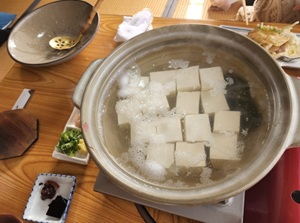
Yudofu means "tofu in boiled water".
It is the dish that only tofu is boiled in a pot in which water and dried konbu for dashi are added.
We eat picked boiled tofu with dipping in the sauce based on shoyu.
This very simple dish has its roots in Buddhist vegetarian cooking eaten by monks in Zen temples to supplement their protein while observing strict precepts.
Therefore, its place of origin is said to be around Nanzenji Temple in Kyoto city.
Many restaurants of yudofu are found in Kyoto.
In particular, there are several renowned restaurants around Nanzenji.