
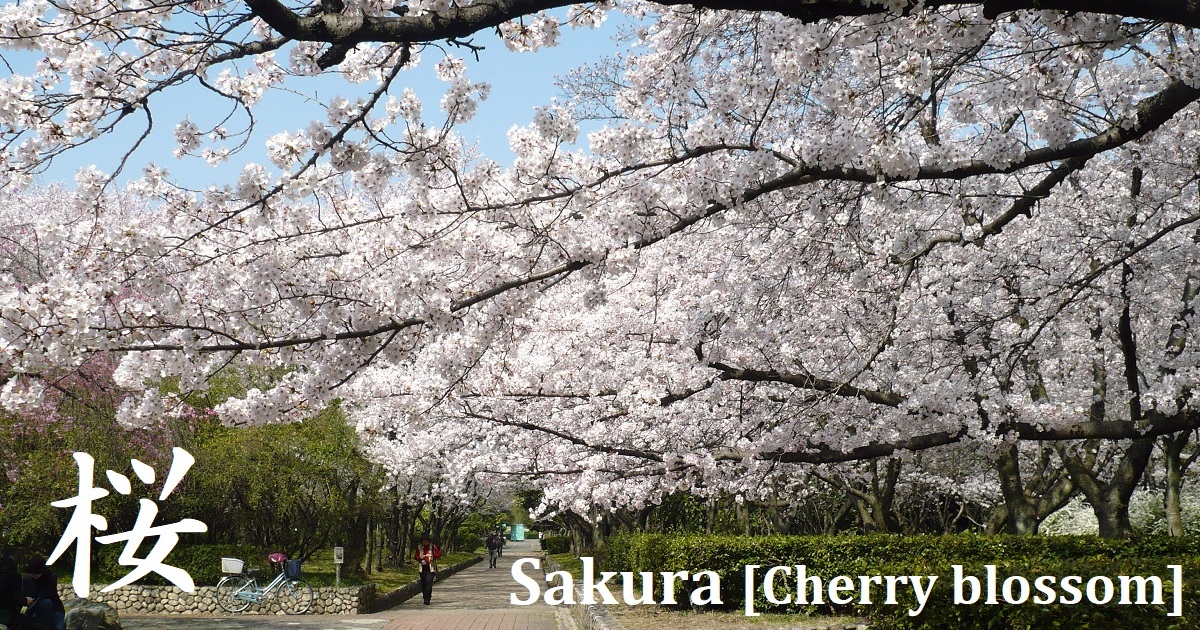
Sakura (Cherry blossom) in Japan
Kinds of cherry blossom in Japan
Soumei-Yoshino
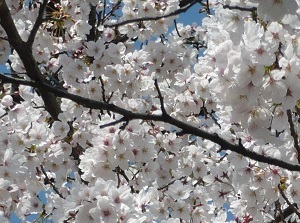
Somei-Yoshino is a cherry blossom variety planted everywhere across most regions of Japan.
When we simply says "Sakura", it refers to this Somei-Yoshino.
In the 18th century, this was created by the gardeners in Somei Village near Tokyo through the crossbreeding of a few wild cherry trees.
The blossoms burst into bloom all at once on bare branches, and the leaves emerge after the blossoms begin to fall.
This is a characteristic not found in the wild cherry trees.
And, Somei-Yoshino trees cannot produce seeds.
So, Somei-Yoshino cannot grow in the wild and has been propagated by grafting.
Therefore, all Somei-Yoshino trees are clones sharing the same genes.
For this reason, Somei-Yoshino trees in the same area bloom and shed their blossoms at roughly the same time.
The color of the blossoms is paler and more elegant than the pink of wild cherry blossoms.
And, the dramatic spectacle of their simultaneous blooming captured the hearts of the Japanese people.
So, many trees of Somei-Yoshino has been planted across the country since the 19th century.
They can be seen particularly often in town parks, school playgrounds, and along riverside paths.
In the major areas, the blossoms bloom around the end of March, and the best viewing period lasts until early April.
However, Somei-Yoshino trees do not grow in Okinawa because it is too warm, and in the northern and eastern parts of Hokkaido because it is too cold.
Shidare-zakura (Weeping cherry)
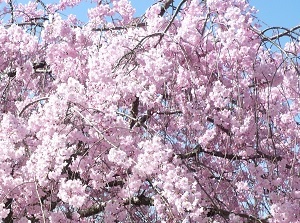
Shidare-zakura is a kind of cherry tree with long drooping branches.
In English, it is tranlated as "Weeping cherry".
Because the branches are soft, they droop gracefully.
The impressive shape stands out in many cherry trees.
The color of the blossom is somewhat deeper than Somei-Yoshino.
Shidare-zakura trees have been cherished since ancient times, and there are many hybrid varieties.
The lifespan of Somei-Yoshino is 70 to 80 years, but the lifespan of Shidare-zakura is over 300 years.
Shidare-zakura trees bloom at roughly the same time as Somei-Yoshino cherry trees.
Kanhi-zakura (Taiwan cherry)
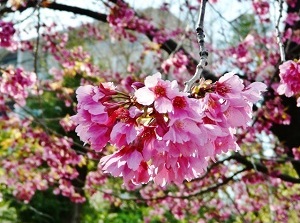
Kanhi-zakura is an early-blooming cherry, and blooms in February in the mainland of Japan.
It is originally a kind of cherry growing in warm area, and is distributed mainly in Taiwan and southern China.
Therefore, the English name is "Taiwan cherry".
In Japan, the main cherry blossom in Okinawa islands is this Kanhi-zakura.
In Okinawa, it blooms in January.
Oshima-zakura
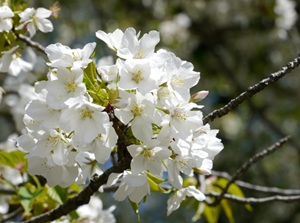
Oshima-zakura is one of species endemic to Japan, and is distributed in Izu Peninsula and Oshima Island located about 100 km south of Tokyo.
It is wild cherry, and Somei-Yoshino was created as a result crossing Oshima-zakura with the other kind of cherry.
The color of the blossoms is white.
The trunk of this cherry tree is used for making charcoal.
"Sakuramochi" is a variety of Japanese confectionery and pink rice cake filled with red bean paste is wrapped with a cherry leaf pickled in salt.
It is the leaf of Oshima-zakura.
Kawazu-zakura
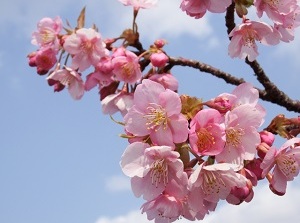
Kawazu-zakura is an early-blooming cherry, and blooms from late January to February.
The color of blossoms is deeper than Somei-Yoshino, and continue blooming for about a month.
In 1955, it was found as a new species by chance in Kawazu town in Izu Peninsula.
It is thought that the tree is a natural hybrid of Oshima-zakura and Kanhi-zakura.
Of course, the main area of Kawazu-zakura is Kawazu town.
Many trees of Kawazu-zakura are planted about 3 km along Kawazu River.
And Kawazu Sakura Festival is held from around February 10 to March 10 every year.
Ezo-Yamazakura
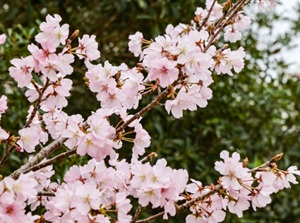
Ezo-Yamazakura is a wild cherry in Hokkaido Island and northern Honshu Island.
"Ezo" means old Hokkaido, and "Yamazakura" means wild cherry.
(It is also called "Oyamazakura".)
In English, it is called "North Japanese hill cherry".
The northern limit of Somei-Yoshino is around Sapporo in Hokkaido.
Instead of Somei-Yoshino, the main cherry in Hokkaido is this Ezo-Yamazakura.
The main season is from late April to May.
Progress of Sakura blooming
Until blooming
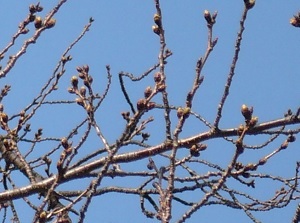
About one week before blooming
In major regions of Japan, Sakura buds become noticeable on the bare branches in early March.
Weather companies are beginning to release forecasts for Sakura blooming dates across the country.
The flower buds grow day by day in mid-March.
And, the tips of the buds become rounded and a pink part begins to appear.
Two or three days later, the blossom opens.
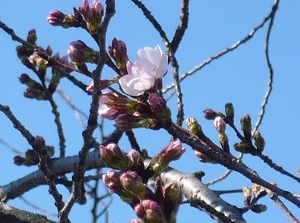
First blooming
At first, only one or two blossoms bloom on a tree.
The Japan Meteorological Agency has designated the sample cherry tree in 58 cities across the country for observation.
And, during this season, the staff members visually check the blooming status of the tree every day.
If five or six blossoms are found open, the Japan Meteorological Agency declares cherry blossom blooming date in the city and the date is officially recorded.
Until full blooming
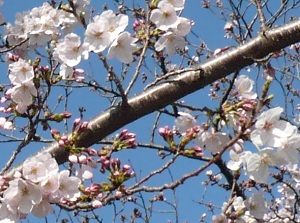
30% in bloom
After the first bloom, the number of open blossoms gradually increases day by day.
The cherry tree is gradually becoming buried in the blossoms.
Cherry blossom trees bloom almost simultaneously, so you can see cherry blossoms all over the town.
In the parks with many cherry trees, an increasing number of people begin holding "Hanami" picnics enjoyed under the cherry trees.
There are also places that are illuminated at night, allowing for night-time cherry blossom viewing.
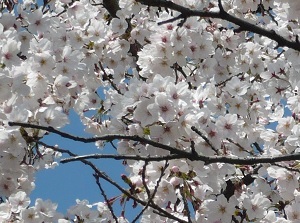
Full bloom
The Japan Meteorological Agency declares "Full bloom" for Sakura in the city when more than 80% of the buds on the trees have opened.
The date is also officially recorded.
Typically, it takes about a week from the first bloom to full bloom.
In major regions of Japan, the full bloom occurs from late March to early April.
After the cherry blossoms reach full bloom, this state lasts for about three days.
After full blooming
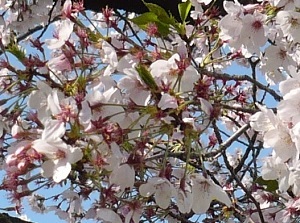
Green leaves appered
A few days after the cherry blossoms reach full bloom, the petals begin to fall.
Since ancient times, that scene has been likened to falling snow.
Many blossoms still remain on the trees, but green leaves are beginning to emerge from among them.
This reminds us that the cherry blossom season is drawing to a close.
For several days, the petals keep falling in large numbers.
The ground under the tree is becoming carpeted with fallen cherry blossom petals.
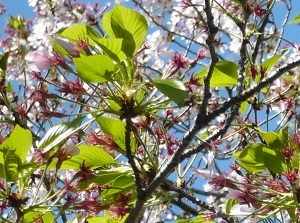
Leaves are growing
The leaves grow rapidly, and within about a week of the flowers beginning to fall, it becomes an ordinary tree covered in young leaves.
The cherry trees spend spring, summer, and autumn with green leaves.
In late autumn, the leaves turn a deep crimson.
In early winter, they have all fallen off.
And then, the trees wait for the spring of the following year.
Cherry Blossom Front
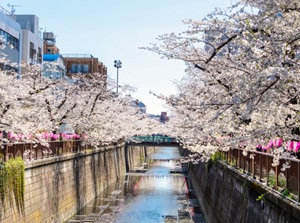
Sakura along Meguro River in Tokyo
First, I will present the past bloom and full bloom dates of Somei-Yoshino in Tokyo as recorded by the Japan Meteorological Agency.
([B] : Bloom date, [F] ; Full bloom date)
2007 : [B] Mar.20, [F] Mar.29
2008 : [B] Mar.22, [F] Mar.27
2009 : [B] Mar.21, [F] Apr.2
2010 : [B] Mar.22, [F] Apr.1
2011 : [B] Mar.28, [F] Apr.6
2012 : [B] Mar.31, [F] Apr.6
2013 : [B] Mar.16, [F] Mar.22
2014 : [B] Mar.25, [F] Mar.30
2015 : [B] Mar.23, [F] Mar.29
2016 : [B] Mar.21, [F] Mar.31
2017 : [B] Mar.21, [F] Apr.2
2018 : [B] Mar.17, [F] Mar.24
2019 : [B] Mar.21, [F] Mar.27
2020 : [B] Mar.14, [F] Mar.22
2021 : [B] Mar.14, [F] Mar.22
2022 : [B] Mar.20, [F] Mar.27
2023 : [B] Mar.14, [F] Mar.22
2024 : [B] Mar.29, [F] Apr.4
2025 : [B] Mar.24, [F] Mar.30
2026 : [B] Mar.19, [F] Mar.28
Of course, these dates vary depending on the weather that year.
But, mostly, the bloom date is in late March, and the full bloom date is one week to ten days later.
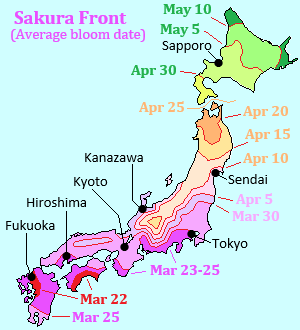
Because the south half of Japan lies from east to west, the main cities such as Nagoya, Kyoto, Osaka, Hiroshima, and Shikoku island and Kyushu island are located at a latitude close to that of Tokyo.
Therefore, in these cities, the date of full bloom is different from Tokyo only within a few days.
From Hokuriku Region through Tohoku Region to Hokkaido island, the latitude progressively increases from Tokyo.
Also, in the central part of Honshu, even urban areas are situated at elevations of several hundred meters.
In terms of climate, the arrival of spring is also progressively later in the regions.
After full bloom in Tokyo, it reaches Kanazawa a week later, Niigata and Sendai 2 weeks later, Aomori 3 to 4 weeks later, and Sapporo a month later.
After enjoying the cherry blossoms in Tokyo, if you visit northern regions, you can enjoy them at their peak once again.
The news of Somei-Yoshino bloom moving northward across the Japanese Islands from south to north is likened to a weather front and is called Cherry blossom front.
In Okinawa islands, Kanhi-zakura is in full bloom in early Februally.
In northern and eastern Hokkaido, Ezo-Yamazakura finally reach full bloom in early May.
How to enjoy Sakura
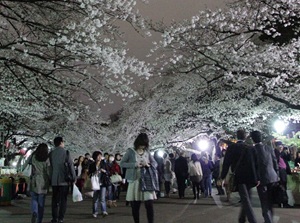
Ueno Park in Tokyo at night
For Japanese people, viewing the beautiful cherry blossoms in full bloom once a year is a major event.
Let's go to a place with many cherry blossom trees and enjoy the scenery while taking a leisurely stroll.
In some area, there are the places that are illuminated at night.
You can enjoy the night-time cherry blossom viewing.
But, you should observe the following manners.
In particular, foreign tourists tend to be insensitive about these.
- Don't break off the cherry branches.
- Don't climb up a cherry tree.
- Don't shake the tree to make the petals fall.
- Don't write graffiti on the cherry trees.
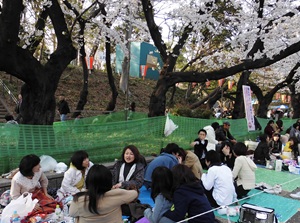
Hanami in Ueno Park
In Japan, there has been a custom called Hanami in the Sakura season.
It is like a picnic under the cherry trees.
A group of family, close friends, or workmates lays out a sheet or a mat under a favorite cherry tree.
They bring some foods and drinks.
They sit down on the mat, chat and see the cherry blossoms while drinking and eating the foods.
But, since it takes place on the ground in public areas, the areas for Hanami are limited.
You can also have a Hanami picnic freely in the area.
But you should observe the following manners.
- You shouldn't occupy a large space.
- You shouldn't bothers other viewers.
For example, talking or singing a song loudly, smoking, fighting. - Mostly, it isn't allowed to use fire.
You shouldn't smoke or have a barbecue. - Don't throw trash around your place.
You should separate and throw away trash at the designated place or bring the trash back to the home.