
Network of JR lines
Network of Shinkansen
Western Japan from Tokyo
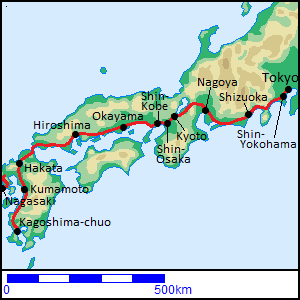
Shinkansen from Tokyo to western Japan
From Tokyo, a Shinkansen line extends to Kagoshima city in the southern end of Kyushu island.
The length is 1,326 km.
Formally, the names of three sections are the followings.
The name is written on the guide board in the station.
- Tokaido Shinkansen (東海道新幹線) : Tokyo ↔ Shin-Osaka (515 km)
- Sanyo Shinkansen (山陽新幹線) : Shin-Osaka ↔ Hakata (554 km)
- Kyushu Shinkansen (九州新幹線) : Hakata ↔ Kagochima-chuo (257 km)
The stations are set up in main cities every few tens of kilometers.
Some station names have "Shin-" at the beginning of words.
The station is set up at the different place from the central station of the city.
All Shinkansen trains pass through many long tunnels.
But Tokaido Shinkansen is old, so the tunnels are less than the other lines.
So, the passengers have a good view of Mount Fuji and Lake Hamana from the window.
And, "Hakata" is the central station of Fukuoka city, and "Kagoshima-chuo" is the central station of Kagoshima city.
The trains of Sanyo Shinkansen run through Shin-Kanmon undersea tunnel (18.7 km) between Honshu and Kyushu islands.
In addition, the branch line from Hakata to Nagasaki in Kyushu Island is planned and a short section (Takeo-Onsen - Nagasaki, 66 km) was partly opened in 2022.
It is Nishi-Kyushu Shinkansen (西九州新幹線), the passengers by limited express of conventional JR line transfer to the Shinkansen at Takeo-Onsen station.
Trains between Tokyo and Shin-Osaka
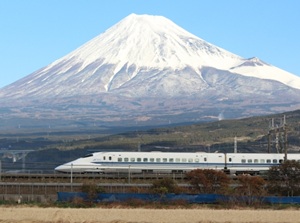
Tokaido Shinkansen running in Shizuoka Prefecture
This section was opened as the first Shinkansen in 1964.
The maximum speed of the train is 285 km/h.
There are many big cities such as Tokyo, Yokohama, Nagoya, Kyoto and Osaka on the line.
So, very many passengers use this line every day, and the trains run every some minutes like commuter train.
Three types of limited express are operated.
- Nozomi (のぞみ) : The fastest train. It stops at only big stations.
(Japan Rail Pass is not available !) - Hikari (ひかり) : The second fastest train. It stops at some main stations.
- Kodama (こだま) : It stops at all stations.
By Nozomi, from Tokyo, it takes 1 hour 35 minutes to Nagoya, 2 hours 10 minutes to Kyoto, 2 hours 25 minutes to Shin-Osaka.
Some trains go into Sanyo and Kyushu Shinkansen.
Tokaido Shinkansen is managed by JR-Central company.
Trains between Shin-Osaka and Kagoshima-chuo
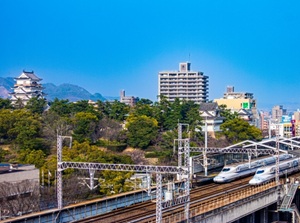
Sanyo Shinkansen, Fukuyama station & Fukuyama Castle
The area of Sanyo Shinkansen is mountainous.
So, half of the route is in tunnel.
The maximum speed of Sanyo Shinkansen is 300 km/h.
The maximum speed of Kyushu Shinkansen is 260 km/h.
The following types of limited express are operated in this section.
- Mizuho (みずほ) : The fastest train. It stops at only big stations.
(Japan Rail Pass is not available !) - Sakura (さくら) : The second fastest train. It stops at some main stations.
- Kodama (こだま) : It stops at all stations of Sanyo Shinkansen.
- Tsubame (つばめ) : It stops at all stations of Kyushu Shinkansen.
- Kamome (かもめ) : All of Nishi-Kyushu Shinkansen.
Sanyo Shinkansen is managed by JR-West company.
Kyushu and Nishi-Kyushu Shinkansen are managed by JR-Kyushu company.
Northern Japan from Tokyo
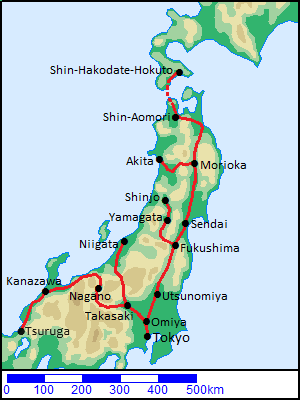
Shinkansen from Tokyo to northern Japan
From Tokyo, Shinkansen trains depart to main three directions.
- Tohoku Shinkansen (東北新幹線) : Tokyo ↔ Shin-Aomori (675 km)
- Joetsu Shinkansen (上越新幹線) : Tokyo ↔ Niigata (301 km)
- Hokuriku Shinkansen (北陸新幹線) : Tokyo ↔ Tsuruga (579 km)
Tohoku Shinkansen has three branch lines.
- Yamagata Shinkansen (山形新幹線) : Fukushima ↔ Shinjo (149 km)
- Akita Shinkansen (秋田新幹線) : Morioka ↔ Akita (127 km)
- Hokkaido Shinkansen (北海道新幹線) : Shin-Aomori ↔ Shin-Hakodate-Hokuto (149 km)
The trains of Yamagata and Akita Shinkansen run on the track of JR local lines.
The trains of Hokkaido Shinkansen run through Seikan undersea tunnel (53.9 km) between Honshu and Hokkaido islands.
Trains from Tokyo to northern Japan
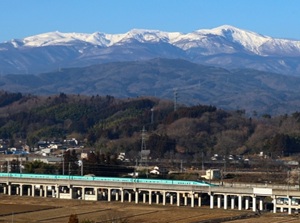
Tohoku Shinkansen in Fukushima Prefecture
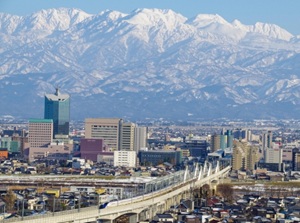
Hokuriku Shinkansen in Toyama city
From Tokyo station, many trains to various directions depart.
The maximum speed of the train of Tohoku Shinkansen is 320 km/h.
The names of the train are determined by the lines.
The design and the color of the trains differ.
Tohoku & Hokkaido Shinkansen
- Hayabusa (はやぶさ) : The fastest train. It stops at only big stations.
- Yamabiko (やまびこ) : The second fastest train. It stops at some main stations.
- Nasuno (なすの) : It stops at all stations between Tokyo and Koriyama.
Yamagata & Akita Shinkansen
These trains are mostly connected to any of above trains from Tokyo, and are divided at Fukushima or Morioka.
- Tsubasa (つばさ) : The train of Yamagata Shinkansen from Tokyo.
- Komachi (こまち) : The train of Akita Shinkansen from Tokyo.
Joetsu Shinkansen
- Toki (とき) : All trains of Joetsu Shinkansen. It stops at some main stations.
- Tanigawa (たにがわ) : It stops at all stations between Tokyo and Echigo-Yuzawa.
Hokuriku Shinkansen
- Kagayaki (かがやき) : The fastest train. It stops at only big stations.
- Hakutaka (はくたか) : The second fastest train. It stops at some main stations.
- Asama (あさま) : It stops at many stations between Tokyo and Nagano.
- Tsurugi (つるぎ) : It stops at many stations between Toyama and Tsuguga.
These shinkansen in Honshu island are managed by JR-East company.
About the western section of Hokuriku Shinkansen is managed by JR-West company.
And, Hokkaido Shinkansen is managed by JR-Hokkaido company.
Network of all JR lines
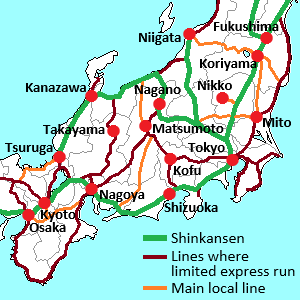
Main lines of JR in central Japan
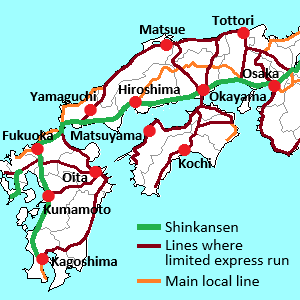
Main lines of JR in western Japan
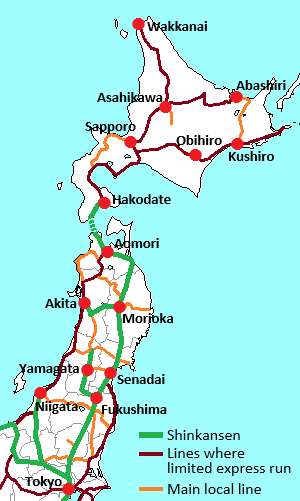
Main lines of JR in northern Japan
These are the main lines of JR.
Shinkansen is the main trunk of JR, and conventional lines of JR cover whole Japan.
JR is managed by the following six companies.
Types of JR train
Basically, JR has three types of train.
- Local train ("Futsū", 普通) : It stops at all stations.
- Rapid train ("Kaisoku", 快速) : It stops at only main stations.
- Limited Express ("Tokkyū", 特急) : It is fast long-distance train and stops at main cities.
- Shinkansen (新幹線) : It is very fast limited express running on exclusive rails.
Because rapid train stops at only main stations, it is faster than local train.
When you get on limited express, the limited express fee is added to the fare.
Shinkansen is also a kind of limited express, and the limited express fee for Shinkansen is added to the fare.
Reserved-seat car and Green car
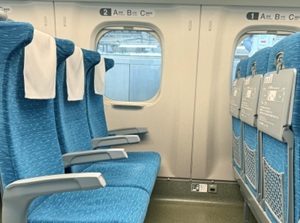
Reserved seats with the seat number.
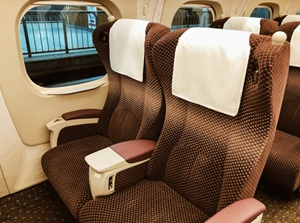
Seats in Green car
Most cars in the train of Limited express and Shinkansen are Reserved-seat cars.
When you get on the car, it is required to reserve a seat in advance for boarding.
Even if you have Japan Rail Pass, you must get on the reserved-seat ticket.
Green car is like a first-class car.
The seat is comfortable and the inside of the car is quiet.
A few cars in the train of Limited express and Shinkansen are "Green cars".
When you get on a green car, you must buy a green-car ticket.
There is no dining car in Japan
Now, there is no dining car in all trains in Japan.
Only one night train is operated
Because JR is a nationwide railway company, many night trains had ever been operated on most main lines every day.
But, because many passengers select Shinkansen or airplane to reach their destination within that day, the demand for night train fell away.
Now, only one night train is operated. (Tokyo ↔ Izumo, Takamatsu)
Rather, the operation of night bus is increasing.
If you want to travel in one night, you should select night bus.
JR Loop lines in Tokyo and Osaka
Yamanote Line
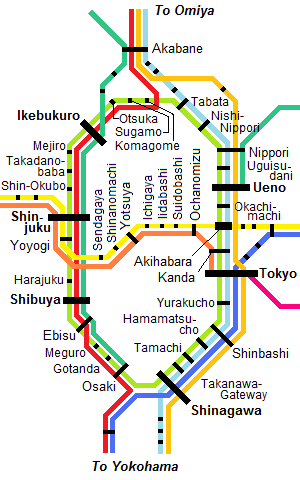
Various train routes in central Tokyo
Yellow green line is Yamanote Line.
There is a loop line of JR in central Tokyo.
It is called Yamanote Line.
It connects Tokyo station and main downtowns such as Shibuya, Harajuku, Shinjuku, Ikebukuro, Ueno, Akihabara, etc.
The length is about 35 km and there are 30 stations.
The train runs around the loop line in 65 to 70 minutes.
The trains are operated every 4 or 5 minutes from 5 a.m. to 1 a.m.
In addition, from Tokyo station to Shinjuku, there is Chuo Line and it runs in the center of the loop.
This is also convenient train.
Yamanote Line is basically a commuter train, so it is often crowded.
Rush hour trains are packed.
Osaka Loop Line
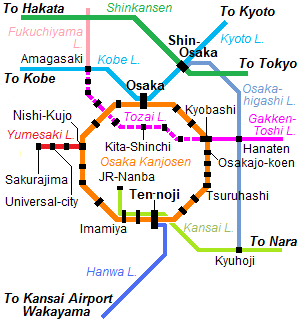
In central Osaka, there is Osaka Loop Line.
It is called "Osaka Kanjosen" in Japanese.
It passes Osaka station (the north terminal in Osaka), Osakajo-koen (near Osaka Castle), Ten-noji (the south terminal in Osaka), etc.
The length is about 22 km and there are 19 stations.
The train runs around the loop line in about 45 minutes.
The trains are operated every 4 or 5 minutes from 5 a.m. to 12 a.m.
Unlike Yamanote Line in Tokyo, the trains to go to various destinations around Osaka also run on this line.
So, the passengers must check the coming train.