
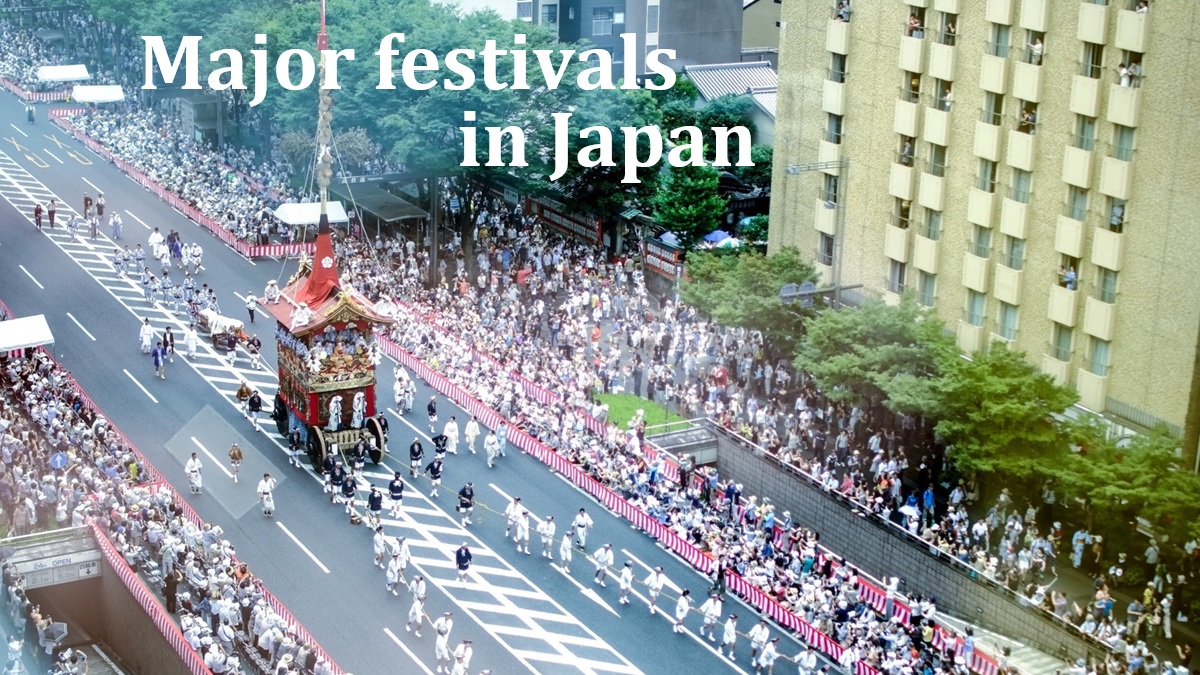
Major festivals in Japan


Traditional festivals in Japan mainly originated shrine ritual.
So, many of them are held as the annual event of the main Shinto shrine in the area.
The town people around the shrine thank the God and pray for huge harvest.
It is Japanese festival that they show various performances for the God splendidly in the areas.
In many big festivals, the following vehicles are used.
The gods living in the shrine are put on them and they parade the town.
The parade is the main event of the festivals.
Mikoshi is a portable shrine on carrying poles and the God of the shrine is in it.
Many parishioners carry the Mikoshi with cheerful shout, and they parade from the shrine through the town.
Dashi is a tall vehicle and a decorated float.
Dolls, the parishioners, children are on the float and many parishioners pull it.
They parade from the shrine through the town.
These festivals using many "Dashi" were designated as UNESCO Intangible Cultural Heritage.
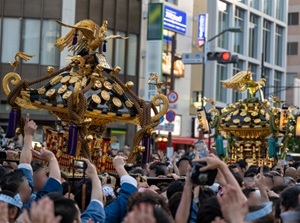
Mikoshi in Sanja Festival in Tokyo
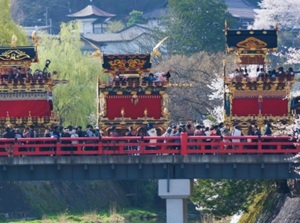
Dashi in Takayama Festival in Takayama city
As the festival of Buddhism, Bon Odori (Bon Dance) is held in many towns in the midsummer.
"Bon" (or "Obon") is a period that ancestors' souls return from the heaven and the day is around August 15.
Bon Odori is a traditional Japanese folk dance and is one of the events to welcome the ancestors' souls, so it is held around the Bon day.
Many people in the area dance in a circle in the evening.
In some cities, the dancing became a big festival and many tourists visit to see the festival.
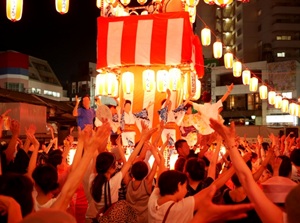
Bon Odori in a town
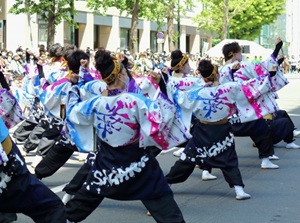
Dance performance in Yosakoi-Soran Festival
in Sapporo city
Some big festivals started in the modern times are not related to the traditional religions.
These have the regional characteristics and attract many tourists.
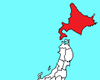
Major festivals in eastern Japan
Hokkaido Region
Sapporo Snow Festival (Sapporo city, Early February)
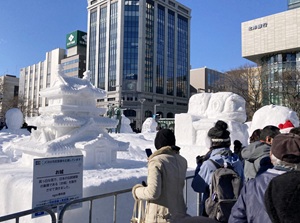
Sapporo Snow Festival
Photo by City of Sapporo
Sapporo Snow Festival is the biggest festival of Hokkaido Prefecture in winter.
It is held for eight days in early Febryuary.
A lot of big snow statues are made in Odori Park in the center of Sapporo city.
Most of them are modeled after famous buildings or popular characters.
And, many ice sculptures are displayed in Susukino district.
Yosakoi-Soran Festival (Sapporo city, Early June)
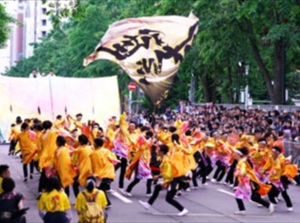
Yosakoi-Soran Festival
Yosakoi-Soran Festival is the popular festival held around Odori Park in Sapporo city in early June.
Over 250 teams consisting of tens of people dance to the folk music of Hokkaido "Soran-bushi".
A student living in Hokkaido watched the Yosakoi Festival at Kochi city, and he began the similar and lively team dance in 1992.
Since then, it has explode in popularity of young people, so it has become one of big festivals in Hokkaido.
Like Yosakoi dance, all dancers dance with "naruko" like a castanet.
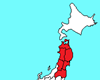
Tohoku Region
Nebuta Festivals (Aomori Pref., 1st week in August)
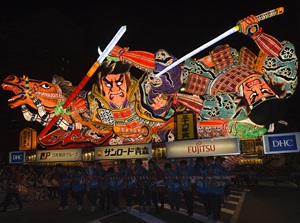
Aomori Nebuta Festival
Nebuta Festivals are held in summer at many cities and towns in Aomori Prefecture.
In some cities, it is called "Neputa".
Nebuta (Neputa) is a big paper lantern in the shape of a warrior and it is set up on a float.
Many floats are paraded with many shouting citizens through the streets in the evening.
The lights inside the lantern create a fantasic sight.
The festivals in Aomori city (Aug. 2 to 7) and Hirosaki city (Aug. 1 to 7) are very popular.
Morioka Sansa Dance Festival (Iwate Pref., August 1 to 4)
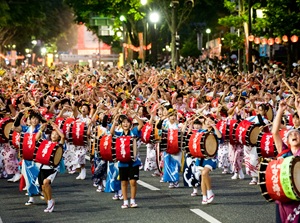
Morioka Sansa Dance Festival
Photo by Tohoku Tourism Promotion Organization
Morioka Sansa Dance Festival is the parade of great Bon dance held in the center of Morioka city in Iwate Prefecture.
The parade goes in teams.
Each team has some dancers, pipers and drummers.
The number of drummer is very large, so this is called "the greatest drum parade in Japan".
Visitors can also dance without prior application.
Akita Kanto Festival (Akita Pref., August 3 to 6)
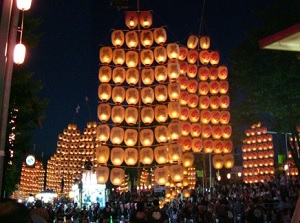
Akita Kanto Festival is held in Akita city.
"Kanto" is a bamboo pole with a lot of "chochin" (paper lantern).
It is the expression of an ear of rice as the hope of a good harvest.
A man hold a kanto pole, and he places it on his shoulder, forehead or hip with balancing and dancing to music.
Main fastival is held in the evening, and the competition of feat is held as the daytime event.
Sendai Tanabata Festival (Miyagi Pref., August 6 to 8)
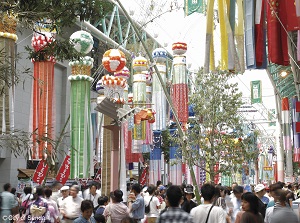
Sendai Tanabata Festival
Photo by Sendai City, Tourism Division
Sendai Tanabata Festival is held in Sendai city.
Tanabata is one of the traditional seasonal festivals in China, and the legend says that Tanabata is about a story of two lovers.
In Sendai city, the festival has been magnificently.
It is generally held on July 7th, but the original lunar calendar is about a month later than current solar calendar.
So, in Sendai, the big festival has been held in earlu August.
Great and gorgeous decorations are hung all over the city.
So, the whole city is filled with the decorations.
Yamagata Hanagasa Festival (Yamagata Pref., August 5 to 7)
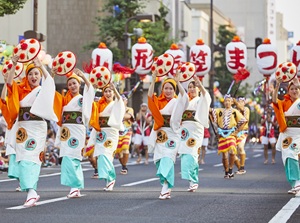
Yamagata Hanagasa Festival
Photo by Yamagata Prefecture
Yamagata Hanagasa Festival is held in Yamagata city.
"Hanagasa" is a sedge hat decorated with some red blossoms.
Many dancers with hanagasa go dancing to the folk music "Hanagasa-ondo" through the streets.
The call in Hanagasa-ondo comes from a call that the workers tamped down the ground.
Current song has been mixed with various songs during about a century.
Soma Nomaoi (Fukushima Pref., 3 days from last Saturday in May)
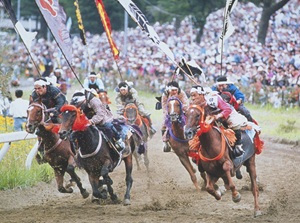
Soma Nomaoi
Photo by Tohoku Tourism Promotion Organization
Soma Nomaoi is the festival reenacted an ancient cavalry battle.
It is held for three days in Soma city in Fukushima Prefecture.
Many men wearing ancient samurai armor and more than 500 horses join this festival.
They march through the city and gather at Hibarigaoka field, which is the main venue for this festival.
Some reenactments of battles and races by cavalries are performed there.
Kanto Region
Kanda Festival (Tokyo, Several days around May 15)
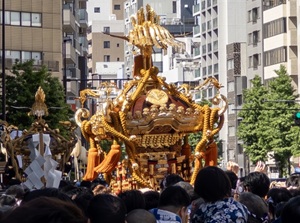
Kanda Festival is held around Kanda Myojin shrine in Kanda district in central Tokyo.
It is the annual festival of Kanda Myojin shrine and has over 400 years of history.
Many people carry a Mikoshi (portable shrine) with spirited call.
It is said that over 200 mikoshi are carried in the festival, so the festival is really an exciting time.
It alternates between "Main Festival" (in odd year) and "Sub Festival" (in even year) every year.
Sanja Festival (Tokyo, For 3 days from the 3rd Friday in May)
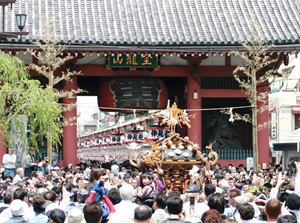
Sanja Festival is the annual festival of Asakusa Shrine in Asakusa district.
Asakusha Shrine is next to the main temple of Sensoji, so this festival is held in whole Asakusa area.
It is said that the festival based on the myth was held in 1312 for the first time.
In the last day (Sunday), many people carry several dozen mikoshi, so there is an air of excitement around the shrine.
Sumida River Fireworks Festival (Tokyo, Last Saturday in July)
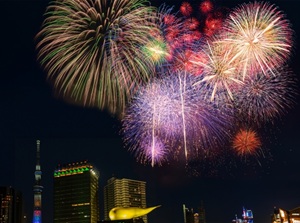
Sumida River Fireworks Festival is a big event of fireworks in midsummer in Tokyo.
Sumida River flows in the eastern side of central Tokyo, and popular districts such as Asakusa, Ryogoku, Tsukiji, etc. are on the riverside.
About 20,000 fireworks are set off in the sky from 19:00 to 20:30.
The places are Sumida River between Asakusa and Ryogoku districts.
About one million people visit the area to see it.
Chichibu Night Festival (Saitama Pref., December 2, 3)
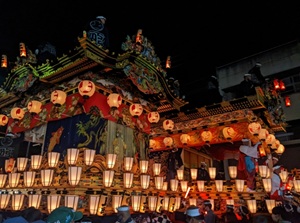
Chichibu Night Festival is the annual festival of Chichibu Shrine in Chichibu city.
It is located in the center of Chichibu city in the western part of Saitama Prefecture, and is about 80 km northwest of Tokyo.
It has been held in December every year since the 1660s.
Six large and decorated Dashi (floats) parade through the streets.
The highlight is the parade by all floats in the last evening.
Major festivals in central Japan
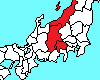
Koshinetsu Region
Yoshida Fire Festival (Yamanashi Pref., August 26, 27)
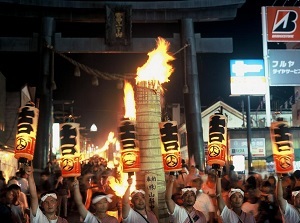
Yoshida Fire Festival
Photo by Yamanashi Tourism Organization
Yoshida Fire Festival is held in Fuji-Yoshida city located at the northern foot of Mount Fuji.
It is the autumn festival of both Kitaguchi-hongu-Fuji-Sengen Jinja and Suwa Jinja shrines.
These shrines are located between Lake Kawaguchi and Lake Yamanaka.
On the first day, two Mikoshi (portable shrine) are carried throughout the city, and about 70 huge torches about 3 meters high are kindled in the evening.
On the second day, two Mikoshi are carried again and they are returned to the original shrines.
Suwa Onbashira Festival (Nagano Pref., Early April & early May)
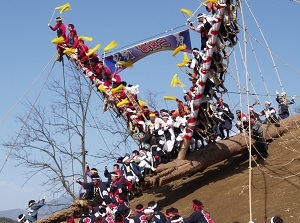
Suwa Onbashira Festival
Photo by Suwa Tourism Association
Suwa Onbashira Festival is the main festival of Suwa-taisha shrine with four shrines.
Suwa-taisha is around Suwa Lake in the center of Nagano Prefecture.
The festival is held in spring every 6 years.
(The next festival is held in 2028.)
Sixteen big fir trees are cut down in a mountain.
In April, the logs are brought a distance of about 12 km from the mountain to the town.
Especially when they take a downhill slide, it is very exciting.
In May, the logs are brought a distance of a few kilometers to each shrine.
And four logs are set up as the sacred pillars in each shrine.
Hokuriku Region
Owara Kaze-no-bon (Toyama Pref., September 1 to 3)
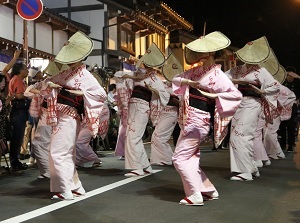
Owara Kaze-no-bon
Photo by Toyama Prefectural Tourism Association
Owara Kaze-no-bon is a Bon dance festival held in Yatsuo town about 15 km south-southwest of Toyama city.
Generally, Bon dance is held in early August, but this is held in early September.
Many dancers in the town dance to the folk song "Etchu-Owara-bushi".
The song is relatively slowly and is like a elegy.
It is played with only Shamisen, Chinese fiddle and Japanese drum.
The dancers dance in silence and the dance is elegant and sophisticated.
Mikuni Festival (Fukui Pref., May 19 to 21)
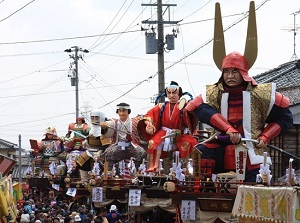
Mikuni Festival
Photo by Fukui Prefectural Tourism Federation
Mikuni Festival is the annual festival of Mikuni Shrine.
The shrine is in Mikuni town near Fukui city, and there is Awara Onsen town near this town.
Six decorated floats are pulled throughout the town.
The symbol of this festival is the huge dolls on the floats.
They are the dolls of historic warlords, heroes or Kabuki actors, and are created newly every festival.
The people in Mikuni town have enthusiasm about creation of the big and dignified dolls.
Tokai Regions
Konomiya Hadaka Festival (Aichi Pref., Mid or late February)
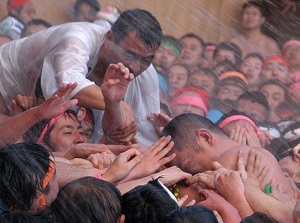
Konomiya Hadaka Festival is the annual festival of Konomiya shrine in Inazawa city near Nagoya city.
"Hadaka" means "naked", and many naked men gather in the shrine in the coldest season.
A sacred man is selected and he becomes a naked god who removes the misfortunes.
In the evening, he dashes into the crowd of many naked men who are at critical ages (25 and 42 years old).
All men try to touch the sacred god to drive away their misfortunes, so the big crowd becomes very exciting and they jostle each other.
After about an hour, the mobbed sacred god accepting many misfortunes is pulled into the shrine at last.
The misfortunes of all men have been removed by the sacred god and the shrine.
Inuyama Festival (Aichi Pref., 1st Saturday & Sunday in April)
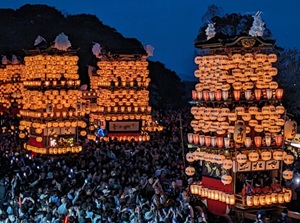
Inuyama Festival
Photo by Inuyama City Tourist Association
Inuyama Festival is held in spring in Inuyama city in the northern part of Aichi Prefecture.
Thirteen Dashi (floats) parade throughout the city.
On the highest floor of Dashi, a Karakuri Doll (Japanese mechanized puppets) is set up, and it moves magically.
Some operators operate the doll on the second floor, and the musicians play music on the lowest floor.
Not only the parade of Dashi but also the show of the Karakuri Dolls is the main attraction.
Takayama Festival (Gifu Pref., April 14, 15 and October 9, 10)
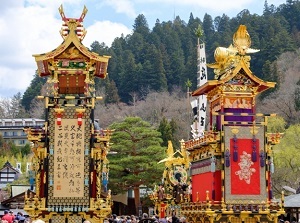
Takayama Festival is held in Takayama city in the northern part of Gifu Prefecture.
The spring festival is the annual festival of Hie Shrine, and the autumn festival is the annual festival of Sakurayama-Hachimangu shrine.
In both festivals, about a dozen beautiful and gorgeous floats are pulled throughout the city.
A few floats have Karakuri Doll (Japanese mechanized puppets) on the top.
These beautiful floats are registered as cultural properties, so when it rains or looks like rain, the parade isn't done.
Gujo Odori (Gifu Pref., Between mid-July and early September)
Gujo Odori
Photo by Gifu Prefectural Tourism Federation
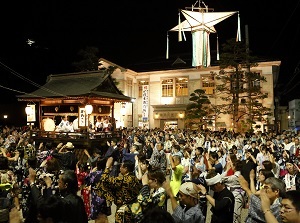
Gujo Odori is the great Bon Festival dance held in Gujo city.
The dance event is held from 20:00 to around 22:30 on Saturday and Sunday in the period.
In August, the event is held in most days.
Especially, around the day of Bon (August 13 to 16), the dance is held all night until 4:00 or 5:00 the next morning.
Gujo Odori is danced to the music called Gujo-bushi.
The musicians play Gujo-bushi on a float, and many dancers dance in a circle around the float.
The dance is easy, so you can join the dance.
Major festivals in western Japan
Kansai Region
Tenjin Festival (Osaka city, From late June to late July)
Tenjin Festival
© Osaka Convention & Tourism Bureau
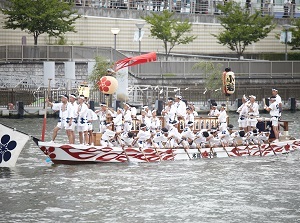
Tenjin Festival is the annual festival of Osaka Tenmangu Shrine.
For about a month from late June to late July, many rituals are held.
Especially, the festival in the last day (July 25) called "Honmiya" is attractive.
Thousand of sacred people parade and mikoshi is also shown.
In the evening, they board on many illuminated boats and parade in Okawa river flowing the center of Osaka city.
Many fireworks are also attractive.
Omizutori (Nara city, March 12)
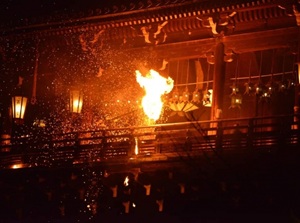
Omizutori is the annual Buddhist ceremony held at Nigatsudo temple in Todaiji in Nara city.
The ceremony has various events, but all of them are held in Nigatsudo by only the priests.
At night, ten or eleven priests hold a large burning torch about 6 meters long individually and run along the upper-level corridor of the hall like balcony.
That is the hightlight of the ceremony.
Visitors can see it under the balcony in front of Nigatsudo.
People believe that exposure to the sparks brings good fortune.
Aoi Festival (Kyoto, May 15)
Aoi Festival
Photo by Kyoto Free Photo
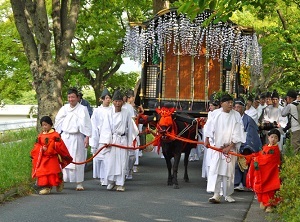
Aoi Festival is the annual festival of Shimogamo Shrine and Kamigamo Shrine.
About 500 people wearing the graceful costume of ancient nobility parade on the road in Kyoto city.
The route is from Gosho (Kyoto Imperial Palace) through Shimogamo Shrine to Kamigamo Shrine, and the distance is about 8 km.
"Aoi" means "hollyhock".
The people wear the leaves of hollyhock.
Guide to Kyoto Imperial Palace Guide to Shimogamo Shrine Guide to Kamigamo Shrine
Gion Festival (Kyoto, July 1 to 31)
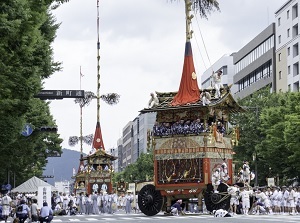
Gion Festival is the annual festival of Yasaka Shrine in Gion district.
As the festival of the shrine, various events are held for a month.
But the most popular events are Yoiyama in the evening from July 14 to 16, and the parade of floats is held on July 17.
In Yoiyama, the beautiful floats with lighted lanterns are set up at many town, and many stalls line there.
On July 17, 32 beautiful floats parade from Shijo-Karasuma through Shijo street, Kawaramachi street and Oike street.
This parade is called Yamahoko Junko.
Guide to Yasaka Shrine Guide to Gion district
Daimonji Okuribi (Kyoto, August 16)
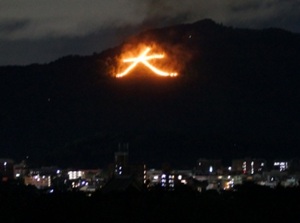
Daimonji Okuribi is a big event in Bon period in Kyoto.
In the evening, five giant bonfires are lit on the mountains to the northwest, north and northeast of the city.
Each of them forms a kanji character or a sign.
Especially the character "Dai" (大) is simple and clear, so it is the symbol of this event.
"Dai" means "big" or "large", and "monji" means "character".
In Bon period, dead souls return to their families, and Kyoto people send the souls to the heaven at the last day of Bon.
Jidai Festival (Kyoto, October 22)
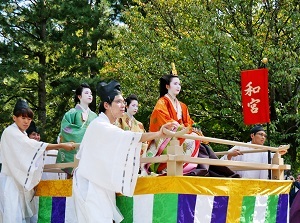
Jidai Festival
Photo by Kyoto Free Photo
Jidai Festival is the annual festival of Heian Shrine.
"Jidai" means "era" or "period".
Eighteen groups of seven historical periods in Japan parade in the city.
About 2,000 people wearing the costume of each era parade.
The length of the procession is about 2 km.
The head of the procession is the group of Meiji Period (the late 19th century), and the following groups go back to the past in sequence.
The route is from Gosho (Kyoto Imperial Palace) through Marutamachi Street, Karasuma Street, Oike Street and Kawaramachi Street to Heian Shrine.
Chugoku Region
Horan-enya (Shimane Pref., Mid-May)
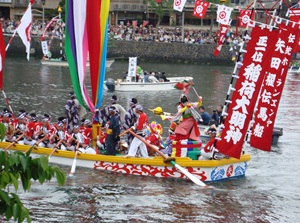
Horan-enya
Photo by Shimane Prefecture
Horan-enya is the festival of Jozan-inari Shrine located in the site of Matsue Castle in the center of Shimane Prefecture.
It is held once every 10 to 12 years.
The last festival was in 2019, and the next festival will be held in 2029.
The boats carrying the God go to Adakaya Shrine 12 km away from Jozan-inari Shrine.
For 7 days, some ceremonies and festivals are held in Adakaya Shrine.
After that, the boats and the God return Jozan-inari Shrine and the festival of dance is held there.
Yamaguchi Tanabata Lantern Festival (Yamaguchi Pref., August 6, 7)
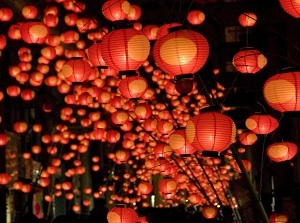
Yamaguchi Tanabata Lantern Festival
Photo: Yamaguchi Prefectural Tourism Federation
Yamaguchi Tanabata Lantern Festival is the summer festival held in the center of Yamaguchi city.
About 100,000 red lanterns (Chochin) over the streets are lighted, and they create a fantastic sight.
It is said that this event has been held since the early 15th century.
In front of the city hall, a tall tree with many Chochin about 15 meters high is set up.
It looks like a Christmas tree in summer.
Shikoku Region
Awa Dance Festival (Tokushima Pref., August 12 to 15)
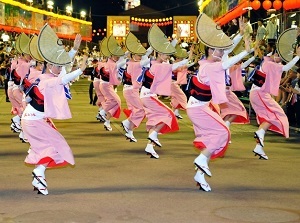
Awa Dance Festival
Photo by Tokushima Prefecture
Awa Dance Festival held in Tokushima city is the biggest Bon dance festival in Japan.
It has a history of over 400 years.
Men dance vigorously or comically, and women dance gracefully but briskly, to the up-tempo music with bell, drum and bamboo flute, etc.
The festival is performed in the form of dancing parade by many dancing teams.
The style of the festival is similar to Rio Carnival.
Yosakoi Festival (Kochi Pref., August 9 to 12)
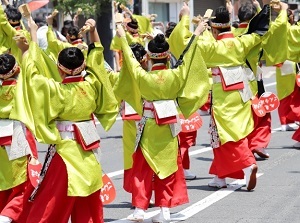
Yosakoi Festival is the summer festival of Kochi city which began to compete with Awa Dance Festival in Tokushima city in 1954.
At first, the main event of this festival was the Bon dance parade with clapping Naruko like castanet.
After that, free arrangement of the dancing and the music was allowed, and many various dancing teams came to join this festival, such as samba, rock, hip hop, Flamenco.
The dance performances are held in many places in Kochi city.
In addition, this festival created "Yosakoi-Soran Festival" in Sapporo city in Hokkaido in 1992.
Kyushu Region
Hakata Dontaku Festival (Fukuoka Pref., May 3, 4)
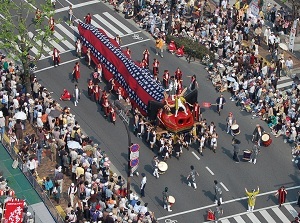
Hakata Dontaku Festival
© Fukuoka Prefecture Tourist Association
Hakata Dontaku Festival is the big annual festival in Fukuoka city.
It is held in "Golden week" that is the best holiday week in Japan".
It is said that the festival started to celebrate the lord in the lord of the area in 1595.
Many various dancing teams march with dancing, and they dance on the stage in several place in the city.
That is the most exciting festival in Fukuoka city.
Hakata Gion Yamakasa (Fukuoka Pref., July 1 to 15)
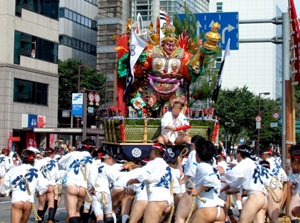
Hakata Gion Yamakasa
Hakata Gion Yamakasa is an annual festival of Kushida Shrine in Fukuoka city.
It is said that the festival has a history of over 800 years.
Yamakasa means Dashi (float), and many tall and beautiful Yamakasa are pulled by many people in the towns.
That has been affected by Gion Festival in Kyoto.
Karatsu Kunchi (Saga Pref., November 2 to 4)
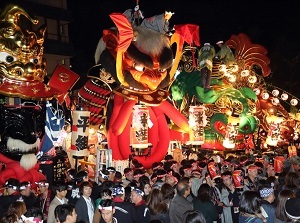
Karatsu Kunchi
© Saga Prefecture Tourist Federation
Karatsu Kunchi is the annual festival of Karatsu Shrine.
It is in Karatsu city and is in the northern part of Saga Prefecture.
The main attraction is the parade of the floats with large papier-mache statues.
But the statues are the excellent craftworks with lacquering and gilding.
Each of 14 districts in Karatsu city has a different statue.
They are lions, fishes, samurai warrior helmets, etc.
Nagasaki Kunchi (Nagasaki Pref., October 7 to 9)
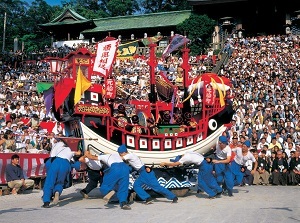
Nagasaki Kunchi
© Nagasaki Prefectural Convention
and Tourist Association
Nagasaki Kunchi is the annual festival of Suwa Shrine in Nagasaki city.
59 towns in Nagasaki city divide into 7 groups, and each group with 7 to 11 towns joins this festival in turns.
Each town shows unique performance.
They are dragon dance, Japanese dance, pulling or carrying floats, and parades.
On the whole, they has been influenced by the traditional culture of Portugal, the Netherlands and China which are the countries traded in the middle ages.
Naha Haarii (Okinawa Pref., Early May)
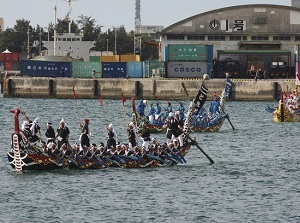
Naha Haarii
Photo by Okinawa Convention & Visitors Bureau
Naha Haarii is the festival of dragon boat race to pray for catching many fish and navigation safety.
It is held in Naha city.
Three large dragon boats compete in speed.
Each boat is about 15 meters long, and 32 rowers, 3 steerers, 2 ringer, and 5 other crewmembers are on board.
Over 100 teams join the race.
And, during the festival, the parades and the other events are held.
Eisaa (Okinawa Pref., Late August)
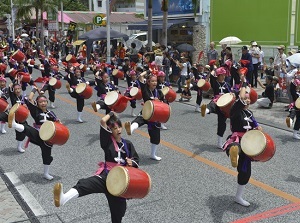
Eisaa
Photo by Okinawa Convention & Visitors Bureau
Eisaa is the Bon dance held in Okinawa Prefecture.
Since the early 17th century, the dance with only Buddhist invocation had been held during Bon season for commemoration of the ancestors.
In the 19th century, young people added folk songs and drums to the dance.
Additionally, showy performances and costumes have been added, and it has developed as the major event of Okinawa.
The festival is held in many cities and towns in Okinawa.