

Flowers, Fields and Forests in Japan


In Japan, 67 percent of the land is forests.
And, 75 percent of the land is mountains.
Grasslands and marshlands are also dotted in such land.
There are four seasons and various plants are growing.
Some fields and forests with valuable are preserved and they are good sightseeing spots.
And the artificial parks of beautiful plants are also attractive.
Sakura (Cherry blossom) in spring

Japanese people have been loving cherry blossoms since ancient times.
The blooming announces the coming of spring, and the people renovate the spirits.
Cherry blossom viewing is a big event in spring for Japanese people.
Some varieties of cherry tree are in Japan, and early-blooming cherry trees are flowering in February.
Most popular cherry tree is "Somei-Yoshino" and a great many trees have been planted throughout Japan.
From late March to mid-April, the blossoms decotare cities and villages in Japan.
Please take a look at the following page and learn about cherry blossom in Japan.
Colored leaves in autumn

Korankei gorge in Aichi Prefecture
In late autumn, the leaves of deciduous trees change color.
The period is from October to November in mountainous areas and the northern part of Japan.
And the period is from mid-November to December in the plains in the southern part of Japan.
There are many kinds of tree in most forests, so we can see the colorful leaves such as red, orange, yellow, and green of evergreen trees.
In the period, many tourists visit picturesque spots for the viewing of colorful leaves.
Main places are the popular mountains, gorges, large Buddist temples, Japanese gardens, etc.
Flowers, Fields and Forests in eastern Japan
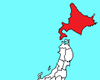
Hokkaido Region
Campus of Hokkaido University (北海道大学)
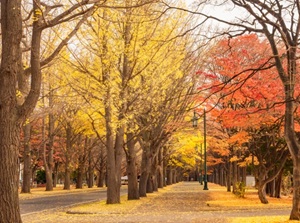
Gingko trees along a street in Hokkaido University
Campus of Hokkaido University is just at north of Sapporo Station.
Of course, it is the site in Hokkaido University.
The original agricultural college was established in 1876, so the campus with farm is very wide.
It is like a natural park.
We can walk on the campus like natural park, so avenues of poplar or ginkgo trees are very popular for visitors.
The visitors can walk around there.
Biei (美瑛)
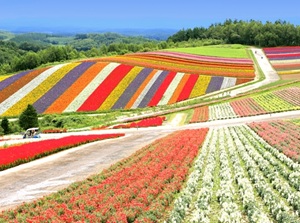
Shikisai-no-oka in Biei town
Biei is a town with many picturesque beautiful hills and un-Japanese landscape.
It is located about 20 km south of Asahikawa city.
Various scenic spots are in the town.
The best season is July and August.
Furano (富良野)
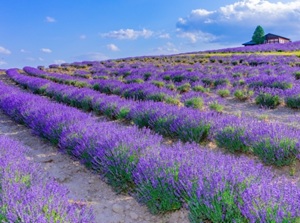
Flower-land in Furano
Furano is also a town with many scenic landscapes and is locate 20 to 25 km south of Biei town.
It is well-known as an area with lavender fields.
The best season is July.
The scenic spots are in the city.
In winter, ski resort is open.
Obihiro (帯広)
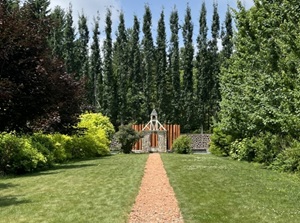
Manabe Garden in Obihiro
Obihiro is a main city positioned in the southeast part of Hokkaido.
Large-scale farming is the main industry.
So, we can see the wide farming areas around the city.
The climate creates beautiful color of flowers, so there are some sightseeing gardens around the city.
Kushiro Marsh (釧路湿原)
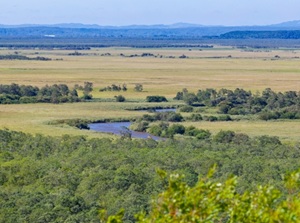
Kushiro Marsh is a broad marsh expanding to the north of Kushiro city.
It is the largest marsh in Japan.
Kushiro River snakes through the marsh and various plants and animals inhabit the marsh.
It was registered as the first wetland under the Ramsar Convention in Japan.
Meruhen no Oka (メルヘンの丘)
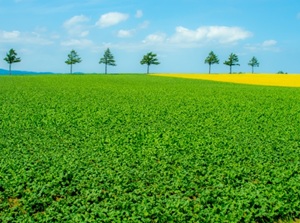
Meruhen no Oka is a gently‐sloping hill with idyllic and beautiful scenery.
It is located to the south-southwest of the center of Abashiri city.
The hill has very gentle ups and downs, and there are the fields of potato and wheat.
This scenery was used in the US-Japan joint movie "Dreams" in 1990.
Higashimokoto Shibazakura Park (東藻琴芝桜公園)
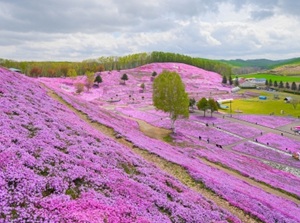
Higashimokoto Shibazakura Park is a flower park in the suburbs of Abashiri city.
"Shibazakura" is a Japanese word meaning "moss phlox".
It is a beautiful pink flower.
Colorful flowers cover the hilly park and the width is about 10 hectares.
The season is from the middle of May to early June.
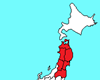
Tohoku Region
Shirakami-Sanchi (白神山地, Aomori & Akita Prefs.)
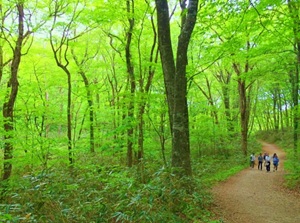
Shirakami-Sanchi is a mountain area between Aomori and Akita prefectures.
The primeval forests are 130,000 hectares in area.
Especially, the old beech forests extend on the mountains, and are one of the widest forests in the world.
It is designated a World Natural Heritage Site.
Ishiwarizakura (石割桜, Iwate Pref.)
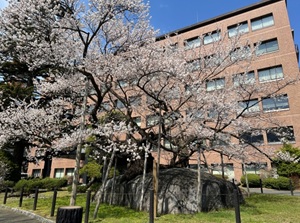
Ishiwarizakura is a unique cherry tree in Morioka city in Iwate Prefecture.
It is in the site of Morioka District Court.
The cherry tree has grown in a cranny of a big rock.
In English, it is translated as "Rock-Breaking Cherry Tree".
It is over 360 years old and the cherry blossoms bloom in late April.
Aoba Avenue, Jozenji Avenue (青葉通, 定禅寺通, Miyagi Pref.)
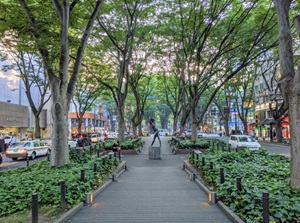
Jozenji Avenue
Aoba Avenue and Jozenji Avenue are two main avenues in Sendai city.
There are many large Japanese zelkova trees along these avenues.
These trees were planted in the 1950s.
Therefore, Sendai city is called "City of trees".
The scenery of the streets is the symbol of the city.
Hanamiyama Park (花見山公園, Fukushima Pref.)
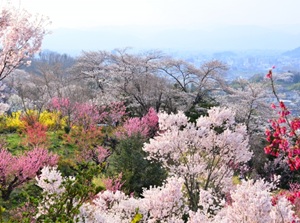
Hanamiyama Park is a flower park on a hill in the suburbs of Fukushima city.
It is a private ground of a flower farm and the whole area is open to the public by the owner.
Various kinds of flowering trees are planted on the hill.
So, they bloom all together in spring.
A celebrated photographer called here "Shangri-La".
Miharu Takizakura (三春滝桜, Fukushima Pref.)
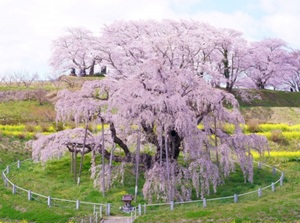
Miharu Takizakura is an old and big cherry tree in Miharu town in Fukushima Prefecture.
It is located about 15 km east of Koriyama city and is near a small dam lake.
It is a kind of weeping cherry and is over 1,000 years old.
It is designated a national monument.
The blossoms bloom in early April.
Kanto Region
Oze marshland (尾瀬, Mainly Fukushima & Gunma Prefs.)
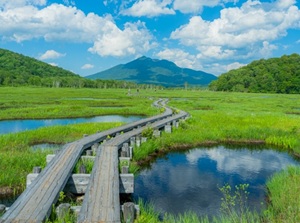
Oze marshland is one of most popular marshlands in Japan.
It spreads over Fukushima, Tochigi, Gunma and Niigata Prefectures and is designed as a national park.
The marsh is located about 1,400 meters above sea level and many precious plants grow.
It is forbidden to drive cars in this area.
Therefore, all visitors must tour around this large area on foot.
Cedar Avenue of Nikko (日光杉並木街道, Tochigi Pref.)
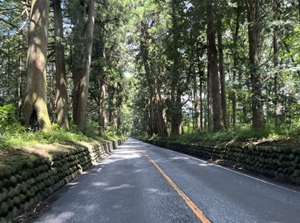
Cedar Avenue of Nikko is the old entrance road to the sacred city of Nikko.
The avenue had constructed in the 1620s, and 200,000 cedar trees were planted.
Even now, the trees are seen around the road to the eastern side of Nikko railway station.
Guide to Cedar Avenue of Nikko
Senjogahara (戦場ヶ原, Tochigi Pref.)
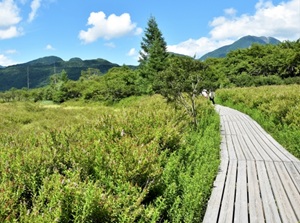
Senjogahara is a marsh extending to the north of Lake Chuzenji near Nikko.
It spreads about 3 to 5 km north of Laku Chuzenji.
It is located at the level of about 1,400 meters and we can see various alpine plants from June to August.
Kirifuri highland (霧降高原, Tochigi Pref.)
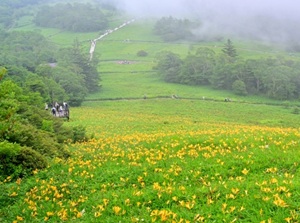
Kirifuri highland is located about 4 to 7 km north of central Nikko city.
It is located at the level of about 1,200 to 1,400 meters.
The most popular spot is Kisuge-daira park and it is covered with countless yellow daylilies (Kisuge in Japanese) in summer.
Ashikaga Flower Park (あしかがフラワーパーク, Tochigi Pref.)
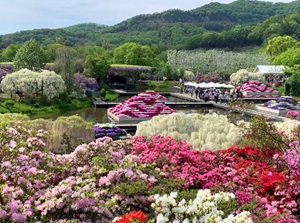
Ashikaga Flower Park is in Asikaga city in the southern part of Tochigi Prefecture.
Many beautiful flowers are seen throughout the year.
Especially, the great Japanese wisteria trellis in early May is most popular and attractive.
Guide to Ashikaga Flower Park in Ashikaga city
Hitachi Seaside Park (国営ひたち海浜公園, Ibaraki Pref.)
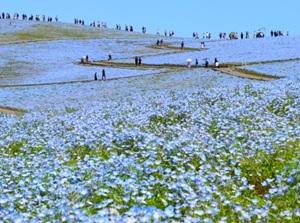
Hitachi Seaside Park is one of National Government Parks in Japan.
It is located in Hitachinaka city in the center of Ibaraki Prefecture.
There are wide flower gardens, grass fields and forests, and we can see the flowers throughout the year.
Especially, nemophila in spring and kochia in autumn are very popular.
Flowers, Fields and Forests in central Japan
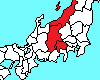
Koshinetsu Region
Hoshitoge Rice Terrace (星峠の棚田, Niigata Pref.)
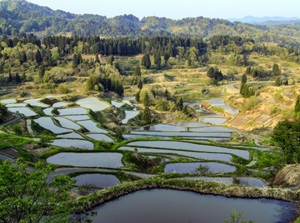
Hoshitoge Rice Terrace is one of the scenic rice terraces.
It is in the center of Niigata Prefecture and is located about 20 km west of the center of Tokamachi city.
On the undulating land in the mountains, many small rice fields are arranged in a staircase pattern.
Fukushimagata (福島潟, Niigata Pref.)
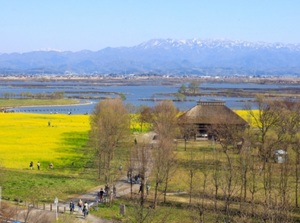
Fukushimagata is a lagoon in the plain including Niigata city.
It is located about 17 km east of the center of Niigata city.
Over 450 kinds of plants grow wildly and more than 200 kinds of wild birds have been recognized in this lagoon.
There is an observation facility and the visitors can the wide scenery.
Aokigahara (青木ヶ原樹海, Yamanashi Pref.)
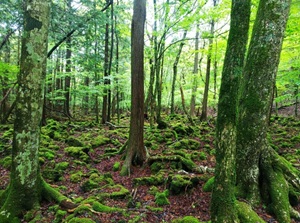
Aokigahara is the forest spreading at the northern foot of Mt. Fuji.
It was formed on the lava plateau after the eruption of Mt.Fuji in 864.
Some walking trails are set up, and we can enjoy walking in the woods.
But the forest is very thick and the ground in the forest is rugged with lava.
So if you have swerved a trail, you may be less able to return the original trail.
Katsunuma (勝沼, Yamanashi Pref.)
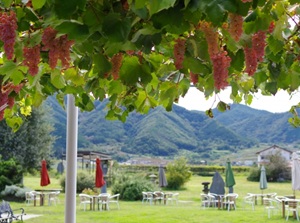
Katsunuma is a famous grape production area in Japan.
It is in Koshu city in the eastern part of Yamanashi Prefecture and is about 100 km west of Tokyo.
Katsunuma Budou-no-Oka (Katsunuma Grape Hill) is the tourist facility for this area.
There is wide vineyard and we can have a tasting of the wine.
Kirigamine (霧ヶ峰, Nagano Pref.)
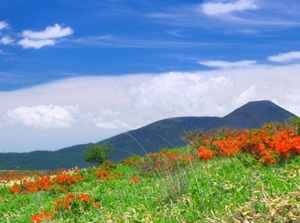
Kirigamine is a shield volcano and is located to the northeast of Lake Suwa in the center of Nagano Prefecture.
The beautiful highland spreads at a height of 1,500 to 1,900 meters on the west slope of the mountain.
It is filled with blossoming alpine plants in summer.
Takato Castle Ruins Park (高遠城址公園, Nagano Pref.)
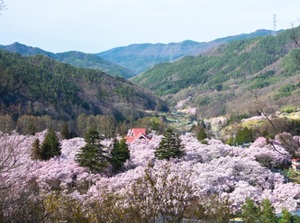
Takato Castle Ruins Park is in Ina city in the southern part of Nagano Prefecture.
Takato Castle was built in the 16th century, but it was demolished in 1872 and became a ruin.
About 1,500 cherry trees are planted in the ruin of the castle, and here is a place famous for its cherry blossoms.
The best season is early April.
Hokuriku Region
Shiroyone Senmaida (白米千枚田, Ishikawa Pref.)
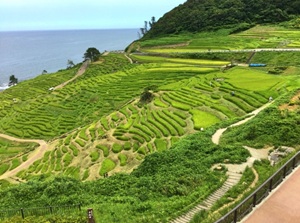
Shiroyone Senmaida is a rice terrace on the steep slope in Noto Peninsula facing the Sea of Japan.
It is located about 10 km east-northeast of the center of Wajima city in the northern part of Noto Peninsula.
It has 1,004 small fields on the slope.
It was damaged by the great earthquake on Janrary 1. in 2024.
But, it is on the road to recovery from the damage.
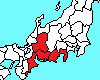
Tokai Region
Asagiri highland (朝霧高原, Shizuoka Pref.)
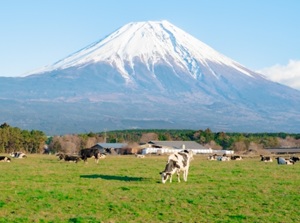
Asagiri highland is the area on the western foot of Mount Fuji.
It ois located about 25 km southwest of Kawaguchiko town which is the main area of the sightseeing of Mount Fuji.
The slope is very gentle, and there are many cattle ranches with broad meadow.
we can see Mount Fuji clearly and widely.
Miho no Matsubara (三保の松原, Shizuoka Pref.)
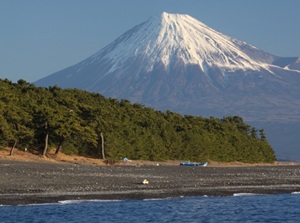
Miho no Matsubara is a pine grove near beach in Shizuoka city.
There are about 54,000 pine trees along the beach for 7 km.
It is one of the best places to see Mt.Fuji.
When Mt. Fuji was registered as a World Heritage Site, the reasons included this beach.
Usuzumi-zakura (淡墨桜, Gifu Pref.)
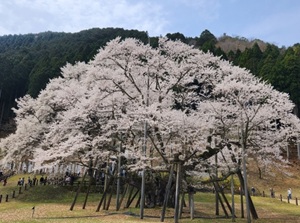
Usuzumi-zakura is an old big cherry tree.
It is located in Neo Valley about 30 km north-northwest of Gifu city.
It is more than 1,500 years old and it began to be dying around 1913.
But many people brought it back to life.
It is a National Natural Monument.
The best season in in the early April.
Nabana no Sato (なばなの里, Mie Pref.)
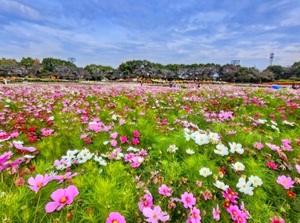
Nabana no Sato in autumn
Nabana no Sato is a flower park located in Nagashima district in Kuwana City.
It is located about 25 km west of Nagoya city.
A lot of colorful flowers bloom in the wide gardens.
Illumination held from mid-October to early May is very popular.
Maruyama Rice Terrace (丸山千枚田, Mie Pref.)
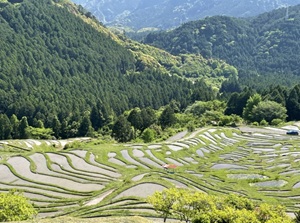
Maruyama Rice Terrace (丸山千枚田, Mie Pref.) is a scenic rice terrace.
It is located to the west of Kumano city.
About 1,340 small rice fields are arranged in a staircase pattern on the the mountain slope.
It is the largest in scale in all over Japan.
Flowers, Fields and Forests in western Japan
Kansai Region
Wazuka tea plantations (和束の茶畑, Kyoto Pref.)
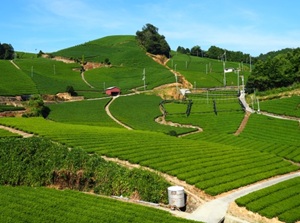
Wazuka tea plantations are the fields of Japanese green tea in Wazuka town.
It is locate about 30 km south of Kyoto city, and Uji city is located about 15 km northwest of this town.
The tea has been produced as Uji tea since ancient times.
The scenery of the fields is beautiful.
Mount Yoshino (吉野山, Nara Pref.)
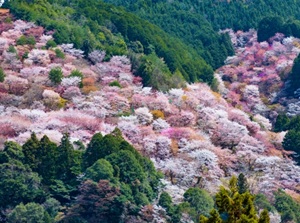
Mount Yoshino is the mountains in the center of Nara Prefecture.
It is located about 40 km south of Nara city.
The area has been a sacred ground and some temples and shrines are dotted.
Since ancient times, cherry trees had been planted in the mountain.
So, there are 30,000 cherry trees in the wide area of the mountains now.
This is the Japan's largest place famous for its cherry blossoms.
The season is from late March to late April.
Chugoku Region
Bitchu-Kokubunji (備中国分寺, Okayama Pref.)
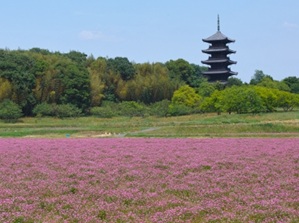
Bitchu-Kokubunji temple and the flowers of "Chinese milk vetch"
Bitchu-Kokubunji temple is a Buddhist temple in Soja city.
It is located about 15 km west of Okayama city.
The temple was founded in 741.
The five-story pagoda is the symbol of this temple.
The scenery of idyllic farming area is attractive and various flowers are in the scenary.
Guide to Bitchu-Kokubunji temple
Ini rice terrace (井仁の棚田, Hiroshima Pref.)
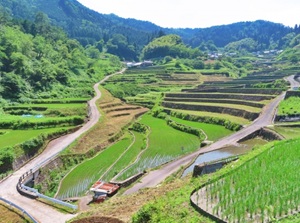
Ini rice terrace is one of the scenic rice terraces in Hiroshima Prefecture.
It is located in the mountain in Aki-Ota town about 40 km north of Hiroshima city.
324 small rice fields are arranged in a staircase pattern.
Akiyoshidai (秋吉台, Yamaguchi Pref.)
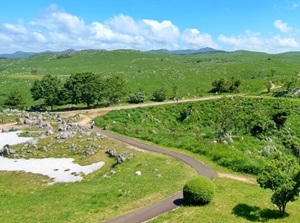
Akiyoshidai is the largest karst tableland in Japan.
It is located about 20 km west of Yamaguchi city.
Countless limestone pinnacles are in the undulating grassland and there are many caves under the ground.
Shikoku Region
Shodoshima Olive Park in Shodoshima (小豆島, Kagawa Pref.)
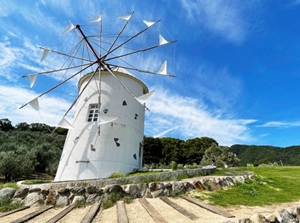
Shodoshima Olive Park (小豆島, Kagawa Pref.) is a unique park in Shodoshima island in Seto Inland Sea.
Olive was introduced to Japan in the beginning of the 20th century, and Shodoshima island has been the suitable center of production.
This park shows the scenery around the Mediterranean Sea where olives are produced.
Kyushu Region
Umi no Nakamichi (海の中道, Fukuoka Pref.)
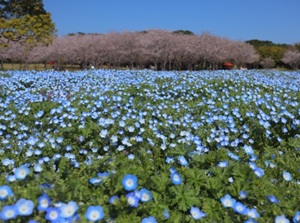
Kaihin Park in Umi no Nakamichi
Umi no Nakamichi is a sand bank near Fukuoka city.
There are wide flower gardens and large grassy fields, and amusement park, zoo, etc. are set up.
Shikanoshima is connected to the sand bank, and the golden seal given from China in the 1st century was excavated in the island.
Nokonoshima (能古島, Fukuoka Pref.)
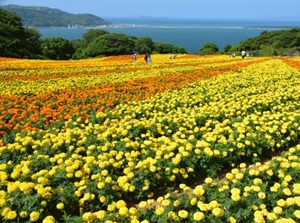
Nokonoshima is a small island in Hakata Bay facing Fukuoka city.
It is about 1 km off the central Fukuoka city.
The flower gardens in the island are popular.
Various flowers bloom throughout the year.
Kawachi Wisteria Garden (河内藤園, Fukuoka Pref.)
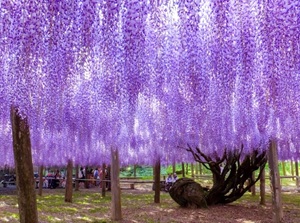
Kawachi Wisteria Garden is a private garden of wisteria near Kitakyushu city.
It is located about 10 km southwest of the central Kitakyushu city.
22 kinds of wisteria flowers bloom in the garden from late April to early May.
You need to make a reservation in the season.
Guide to Kawachi Wisteria Garden
Hamanoura Rice Terrace (浜野浦の棚田, Saga Pref.)
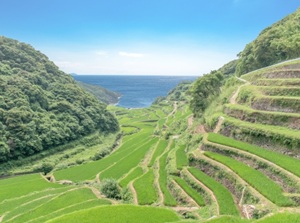
Hamanoura Rice Terrace is on the slope in a narrow valley near a small inlet of Genkai Sea.
It is located about 30 km west of Karatsu city in Saga Prefecture.
283 small rice fields are arranged in a staircase pattern.
Guide to Hamanoura Rice Terrace
Yakushima (屋久島, Kagoshima Pref.)
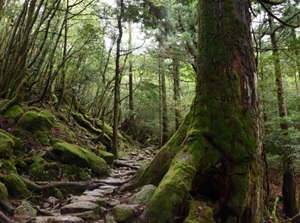
Yakushima is an island with very high and steep mountains.
Rich forests cover the whole island.
Yakusugi trees, a kind of Japanese cedar, grow in the forest and the trees over 2,000 years old are quite common.